Your competitive record determines which visa fits: P-1A requires international recognition, while O-1A requires extraordinary ability supported by sustained acclaim. Planning for P-1 athlete visa legal fees also helps keep your season on schedule. Both classifications allow temporary athletic employment in the United States, but each has its own legal requirements.
We explain a related change of status in our post on moving from F-1 OPT to an O-1 visa in New Jersey.
The choice depends on what your record proves about you as an individual or your standing within an internationally recognized sport. For performers outside athletics, we cover tour planning and P-1B rules for musical artists separately.
Filing requirements need to fit your competition calendar. A technical mistake or poorly matched petition can delay processing, trigger a costly request for more evidence, or force event cancellations. Knowing how federal immigration rules assess athletic careers helps you build a petition that addresses those requirements from the start.
What’s Inside This Guide
Statutory Baselines for Athletic Classifications
Federal law places these petitions under separate sections of the Immigration and Nationality Act. USCIS requires P-1A applicants to show that the athlete or team competes at an internationally recognized level. O-1A applicants must prove extraordinary ability in athletics through sustained national or international acclaim.
Legal requirements for athletic petitions
-
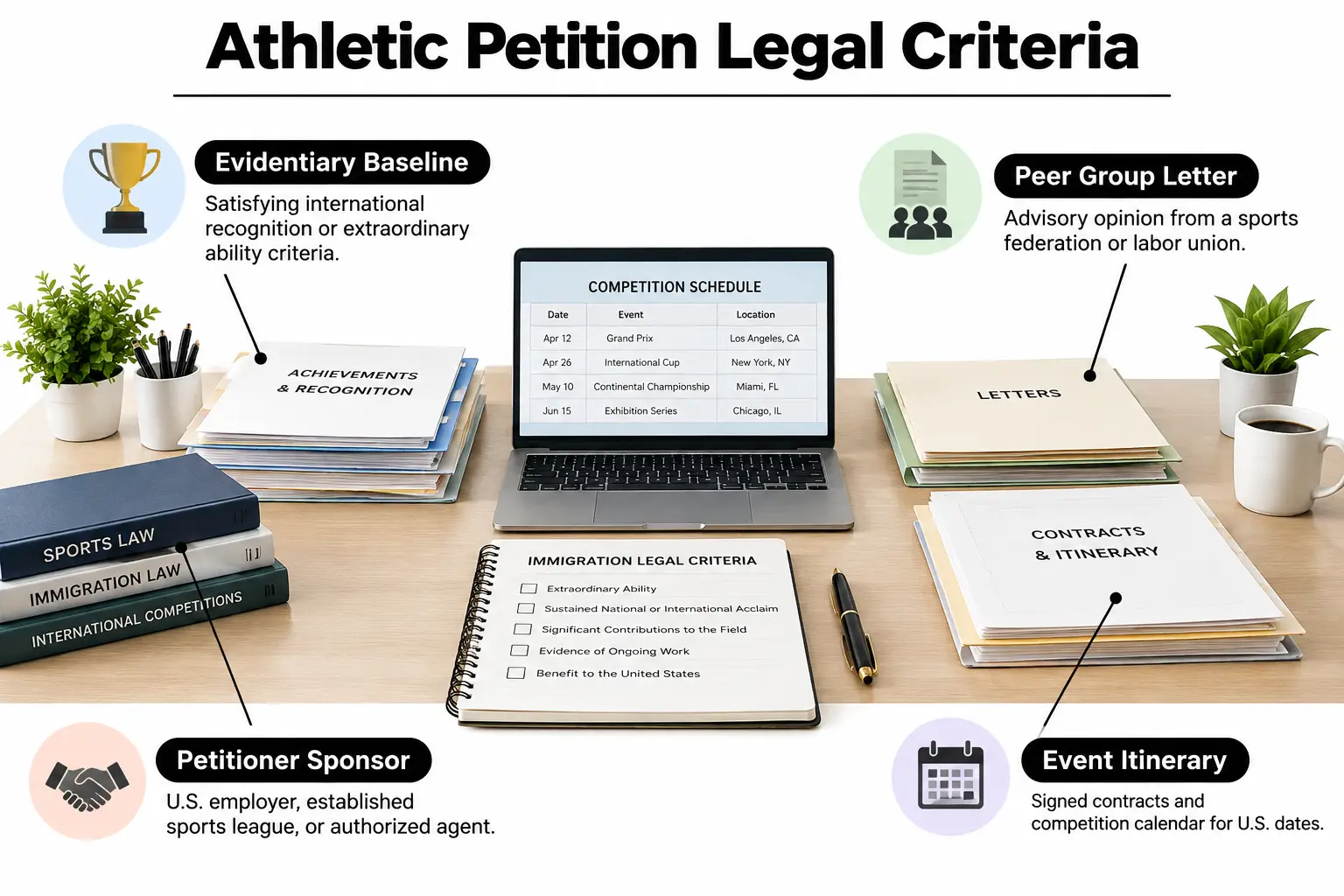
P-1A evidence standard: Documents must show high achievement and skills substantially above the usual level, with recognition in more than one country.
-
O-1A evidence threshold: Applicants must show they belong to the small percentage at the very top of their field. The federal regulations set out this requirement.
-
Peer group opinions: Required consultation letters come from an appropriate labor organization or peer body. They confirm the athlete’s achievements and describe the U.S. competitions.
-
Petitioning sponsor: Athletes cannot file for themselves. An authorized U.S. employer, established sports league, or agent representing multiple employers must file the petition. Our explanation of the petitioner’s role in talent-based visas covers these responsibilities.
Many competitors assume that visas with higher standards are reserved for household names. An established professional career can fit the regulatory criteria without that level of fame. Understanding what each category actually requires helps avoid filing under the wrong one and losing time to preventable delays.
Comparing Athlete Eligibility Across Categories
We assess your level of competition and past honors alongside your team affiliation. Extraordinary ability is not a fit for every athlete. Nor does every team contract meet the international recognition standard for P-1A status, even if the athlete has a strong professional record.

Choosing an athletic visa classification
|
Competitive profile |
Generally covered category |
Legal basis and exceptions |
|---|---|---|
|
Olympic or world championship medalist |
O-1A or P-1A |
Meets the major international award benchmarks for O-1A and clears the P-1A recognition standards. |
|
Member of an international sports team |
P-1A team visa |
Applies when the team has international recognition. Team membership does not automatically qualify an individual for O-1A status. |
|
Top-ranked national competitor |
P-1A (or O-1A with qualifying press) |
Requires proof of international competition. Regional or domestic circuits without overseas participation often fall short. |
|
Essential coaching and training staff |
P-1S support personnel |
Staff travel under separate classifications based on essential, longstanding working relationships with the primary athlete. |
|
Cross-disciplinary performer or creator |
O-1A or O-1B |
Action sports athletes who also work as media influencers often span athletic and creative criteria. Reviewing the O-1B requirements helps clarify these cases. |
Solo athletes in niche sports may struggle to document their standing when no established global rankings exist. Records from sanctioning organizations and published media coverage become especially important in those cases. They help show the level at which the athlete competes and support the claim of eligibility.
Statutory Nuances and Petition Restrictions
Athletic petitions have restrictions that differ from ordinary corporate employment filings. Missing one can create problems during USCIS review, even when the athlete’s competitive record is strong.
Validity Period Ceilings
Individual P-1A athletes may receive an initial stay of up to five consecutive years, with extensions allowing ten years in total. An initial O-1 visa, by comparison, allows a maximum of three years. Its length depends strictly on the event schedule submitted with the petition.
Team Membership Constraints
Approval under a P-1A team petition ties your stay to the team’s contracted competitions and events. Entering individual prize-money tournaments outside that arrangement requires an amended filing.
Amateur vs. Professional Thresholds
Amateur athletes generally cannot obtain P-1A status unless they enter recognized international competitions at an elite collegiate or national team level. Under U.S. Department of State regulations, contracts and stipends serve as standard proof of professional status. Formal prize-money records also support that evidence.
Widespread Misconceptions Surrounding Athletic Visas
Wrong assumptions about talent visas can lead teams to overspend or file under a category that does not fit. Sorting out the requirements early protects time that should be spent training.
-
Myth: An Olympic medal is required for an O-1A visa. Major awards offer a direct route, but applicants can also qualify by meeting at least three alternative criteria. These include substantial published coverage, critical roles with athletic organizations, or high pay.
-
Myth: P-1A visas cover only team sports. Individual competitors regularly obtain these visas in tennis, golf, track and field, combat sports, and equestrian events. They need verifiable international rankings or competitive records to support the petition.
-
Myth: Every talent visa costs the same in legal fees. An O-1A filing generally takes more work to organize and connect the evidence than a standard P-1A petition. That difference affects the legal fees you should budget for each option.
-
Myth: An athletic visa permits any paid U.S. work. Permission is limited to the athletic events, promotional appearances, and coaching listed in the original itinerary. Separate business activities require their own filings rather than relying on the athlete’s existing status.
Responding to USCIS Denials, RFEs, and Procedural Errors
An unfavorable immigration notice does not end your athletic career in the United States. Your next steps matter, though. A careful response helps protect your status and competition schedule while you address the concerns raised by the reviewing officer.
Steps for responding to an adverse visa notice
-
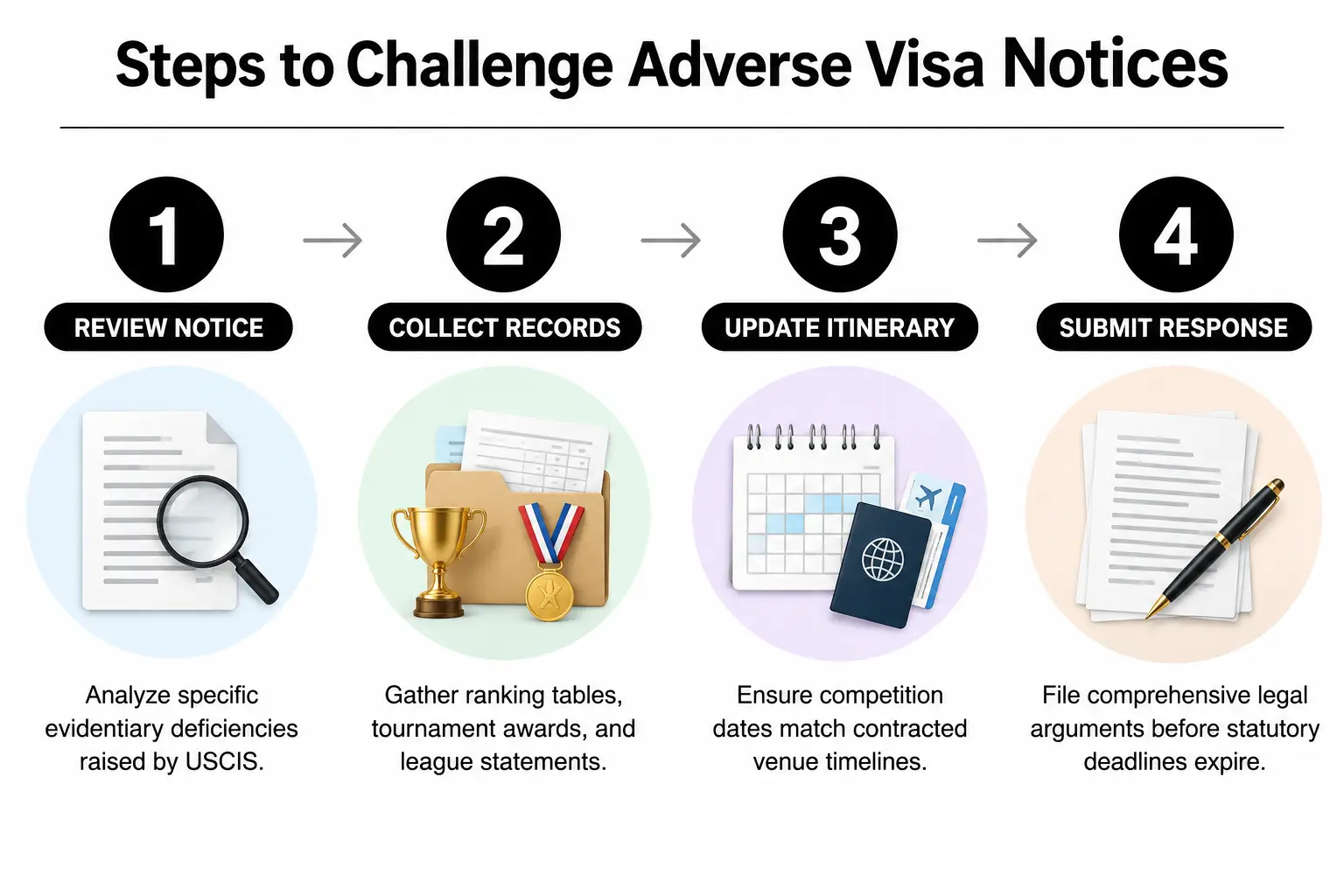
Read the official notice: A Request for Evidence (RFE) asks for more proof. A Notice of Intent to Deny (NOID) signals a possible denial. Identify exactly which requirements the officer believes your evidence has not met.
-
Gather supporting records: Collect past competition results and tournament draw sheets, along with published coverage and sworn letters from governing federations. Match those records to the disputed points.
-
Check the original itinerary: Confirm that the filing included a complete competition calendar covering every venue, supported by established contracts or formal sanctioning letters.
-
Consider another classification: If the O-1A evidence cannot meet the standard, assess whether the record supports a parallel P-1A petition. A future adjustment strategy may also warrant review by a lawyer handling EB-1 cases.
-
Meet every legal deadline: RFEs and appeals have strict response deadlines. Missing the response window results in an administrative denial with prejudice.
Defend your record: Every document in a response should connect directly to a legal requirement in the federal regulations.
Complicated evidence problems often call for help from an attorney handling O-1 petitions or a lawyer experienced with P-1 filings. That review gives athletes a chance to reorganize their evidence before the response deadline passes.
Filing from New Jersey: Training Hubs and Practical Steps
New Jersey has a busy regional sports market that regularly draws international athletes preparing for national leagues and East Coast circuits. Training sites range from Somerset County equestrian facilities to Jersey City combat sports gyms. Newark’s youth development academies are part of that network too.
Federal immigration rules govern petitions filed from New Jersey. Local employment laws and agency licensing rules govern contracts between athletes and U.S. sponsors. Filings must reflect actual training commitments and competition schedules, including professional contracts managed by sports firms or events at MetLife Stadium.
Sports organizations need to budget for legal work alongside required USCIS fees and premium processing charges. For multi-state tours, we at Abachi Law LLC coordinate the filing with the regional competition schedule. Each event needs to fit the federal immigration requirements, regardless of where it takes place.
Answers to Common Athletic Visa Inquiries
How much are standard p1 athlete visa legal fees?
Fees depend on how much work your competitive record needs and whether an agent or employer files the petition. Linked P-1S filings for support staff also affect the cost. Before work begins, a clear scope should explain document preparation and consultation letters, along with government submission costs.
Can an athlete switch from a P-1A visa to an O-1A status while in the country?
Yes. Significant international honors or individual championships earned during P-1A status may support a change to O-1A status. You must submit a new petition with fresh evidence proving sustained international acclaim under USCIS criteria. The earlier P-1A approval does not replace that evidence.
Can independent sports promoters act as visa petitioners?
Licensed sports agents, promotion companies, and event organizers can petition using an established itinerary. Signed contracts, deal memos, or formal competition invitations must support the filing. Those documents need to give the dates and venues for every scheduled event.
Do esports competitors qualify under the P-1A classification?
USCIS recognizes professional esports competitors under P-1A when their tournament or league has established international standing. Streaming figures and prize-pool records help document that standing. Global rankings also help show that the competitor meets the evidence requirements.
How do support personnel join an athlete traveling under an O-1A or P-1A?
Coaches, trainers, and specialized staff apply under O-2 for O-1A athletes or P-1S for P-1A competitors. Sponsors must show that these staff members have essential skills and prior experience. The evidence must also establish their critical knowledge of the athlete’s specific training program.
Legal Guidance for Competitive Athletes and Teams
At Abachi Law LLC, we review your competitive history and contracts against your career goals. Our work on O-1, P-1, and EB-1 petitions covers elite athletes and their coaching staff, as well as sports organizations. That review helps identify the requirements your record needs to meet.
Have your file reviewed before seasonal tournaments, international title fights, or East Coast training camps put pressure on the calendar. Early review helps prevent costly scheduling problems. To discuss your competitive record and filing options, contact our legal team for an initial consultation.
Legal disclaimer: This article is general information, not legal advice, and reading it does not create an attorney-client relationship. Laws change and differ from state to state, and past results do not guarantee a similar outcome. For advice about your own situation, speak with a licensed attorney at Abachi Law LLC.