
Singers applying for talent-based visas need a union advisory opinion from the American Federation of Musicians (AFM) or the American Guild of Musical Artists (AGMA).
For most international vocalists, an O-1B or P-1 petition without a clear, favorable consultation letter triggers a Request for Evidence (RFE) or rejection. An RFE asks you to supply missing or inadequate evidence. Your genre and vocal role, along with the performance setting, determine which union should review your filing.
Mainstream soloists and commercial band singers typically fall under AFM guidelines. Classical opera singers, concert soloists, and choral ensembles must send their materials directly to AGMA. Choosing the wrong union or failing to document your itinerary can cause serious processing delays, putting rehearsals and multi-city tour dates at risk.
What’s Inside This Guide
The True Cost of Union Jurisdiction Mistakes
Federal rules enforced by USCIS require an advisory opinion from the appropriate labor organization before a talent petition is approved. Counsel unfamiliar with a singer’s field may describe it incorrectly. Sending an opera singer’s portfolio to AFM instead of AGMA results in a formal jurisdictional rejection letter, stopping review at the service center.

Reviewing a vocalist’s contracts and union consultation documents
Independent musicians with several contracts face another difficulty: they may not have a permanent employer. Many use an agent-petitioner, an agent who files on their behalf, to cover their American concert dates. Strong streaming numbers, press reviews, and festival recognition cannot make up for a consultation letter that fails to meet the legal requirements.
Labor check: USCIS treats a consultation from the wrong union as no consultation at all, causing immediate delays.
Before requesting an opinion, we need to establish who will file the petition and what their role involves. Getting that wrong early can put scheduled performances at risk, including festival appearances and live broadcasts.
AFM Versus AGMA: Determining Proper Union Jurisdiction
Selecting the Appropriate Bargaining Unit for Your Repertoire
Start by matching your main artistic discipline to the union responsible for it. This avoids a dismissal on procedural grounds. Both organizations assess your standing among peers and your industry impact, but federal immigration guidelines give them different areas of responsibility.
|
Union |
Types of Work Covered |
Key Documents to Check |
|---|---|---|
|
American Federation of Musicians (AFM) |
Pop, rock, jazz, commercial recording, instrumentalist-singers |
Commercial contracts, distribution data, touring itineraries |
|
American Guild of Musical Artists (AGMA) |
Opera soloists, classical concert vocalists, choral singers, recitalists |
Program credits, formal staging contracts, critical reviews |
|
Dual / SAG-AFTRA Overlap |
Broadcast television singers, voice actors, soundtrack vocalists |
Clear broadcast credits and production union affiliations |
Theater and recorded-media work may require a SAG-AFTRA consultation letter for an O-1 visa, especially for film or television broadcasts. At our practice, we regularly handle these filings through our work on talent-based visas. We check that the petition describes your discipline correctly before it goes to the union.
Aligning Visa Categories with Your Vocal Career Stage
An individual extraordinary ability petition needs different evidence from an ensemble petition. Solo vocalists typically pursue an O-1 visa. Backup singers or touring vocal groups may fit the P-1 category, or an O-2 petition for essential support personnel. That choice shapes the evidence you need to gather.
|
Vocal Career Profile |
Recommended Classification |
Approach to Avoid |
|---|---|---|
|
Established Solo Vocalist |
O-1B Extraordinary Ability |
Filing under standard P-1 group rules as an individual |
|
Ensemble / Vocal Band Member |
P-1B Entertainment Group |
Claiming solo distinction without independent media coverage |
|
Recent Music Conservatory Graduate |
O-1B via Agent Petitioner |
Staying on expiring F-1 OPT without building qualifying evidence from peers |
Evidence standard: An O-1B requires sustained distinction, which unions assess closely through commercial results, press coverage, and critical recognition.
Experienced counsel can help you choose the right category before you build the petition. An O-1 visa attorney can assess your record against the O-1B visa criteria and identify common filing mistakes. The aim is to organize evidence that holds up under USCIS review.
Harmonizing Itineraries, Peer Letters, and Labor Consultations
Every part of the petition needs to tell the same story. Match the union request to your deal memos and performance schedule, then check the expert recommendation letters for consistency. Differences between an AFM submission and the final Form I-129 petition can draw close scrutiny from USCIS officers.
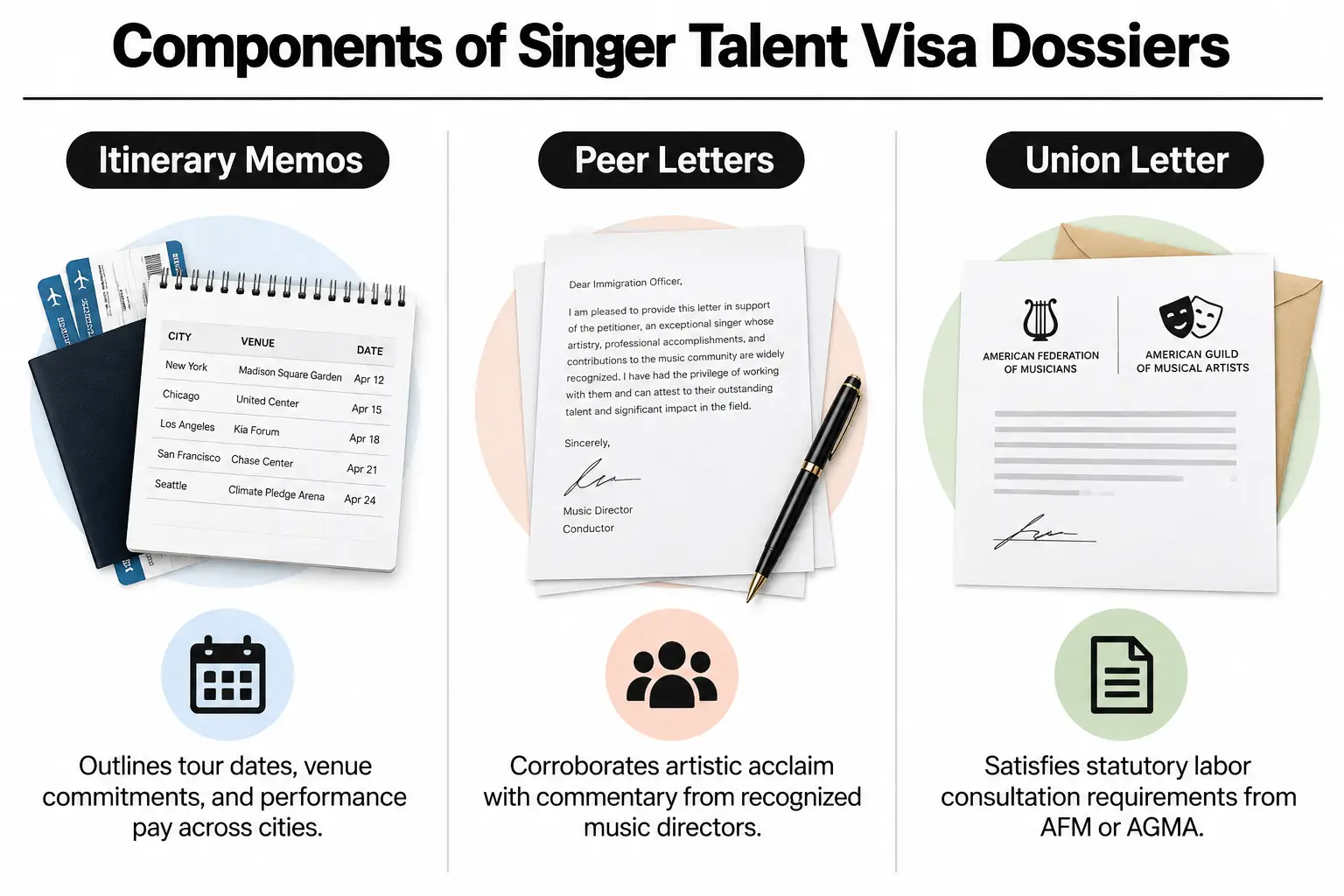
Documents that need to agree in a singer’s visa petition
|
Document |
What the Union Reviews |
How It Is Verified |
Role in the Petition |
|---|---|---|---|
|
Performance Itinerary |
Legitimate venues and fair wages |
Signed contracts or deal memos |
Supports the requested length of stay |
|
Expert Testimonials |
Industry standing and peer recognition |
Signatures from recognized authorities |
Supports the union’s favorable opinion |
|
Press and Media Kit |
Critical acclaim and public visibility |
Major national or trade publications |
Shows sustained professional distinction |
Singers planning a concert series can read our guide to tour planning and P-1B rules for musical artists. Working with an experienced P-1 visa attorney helps ensure the contracts contain enough detail for review. Union reviewers and federal officers both need to understand the work those contracts cover.
Step-by-Step Protocol for Requesting Advisory Opinions
We prepare union requests in a set order so the supporting documents are ready before submission. This is the process we use for vocalists filing petitions across the East Coast:
-
Confirm the union: Check whether the upcoming work involves commercial studio sessions covered by AFM or classical, operatic, or concert repertoire covered by AGMA.
-
Prepare the itinerary: List U.S. venues and performance dates, with compensation for each engagement. Include dates in Newark, Princeton, or Jersey City where applicable.
-
Build the portfolio: Choose your strongest contracts and reviews, along with recommendations from established peers. Our guide to writing testimonial letters for an O-1B arts petition explains how to prepare those letters.
-
Submit the union request: Send the petition cover letter and draft Form I-129 with the supporting exhibits to the union’s immigration office. Include the required review fee.
-
Add the advisory opinion: Check the returned letter for favorable language, then place the sealed or original document directly in the main petition package.
Timing check: Allow two to three weeks for standard union review before you plan to file the petition with USCIS.
Managing Legal Fees, Union Dues, and Expedited Processing
Budget for union assessment dues as well as federal filing fees. These are separate costs in a creative professional’s visa application. Deciding where to spend helps you keep the production budget under control without cutting corners on the filing.
|
Budget Level |
Where to Prioritize Funds |
Costs to Check Closely |
|---|---|---|
|
Essential ($) |
Standard union consultation fees, required I-129 government fees |
Overnight courier charges when the union accepts online submissions |
|
Mid-Range ($$) |
Expedited union processing, tailored agent-petitioner agreements |
Unneeded duplicate peer letters from non-signatory regional associations |
|
Comprehensive ($$$) |
USCIS Premium Processing, full legal representation for multi-gig tours |
Separate petitions for each venue instead of one consolidated agent filing |
Compare the cost of an O-1 visa lawyer with the potential losses from a canceled tour or festival penalties. Longer-term plans deserve attention too. An experienced EB-1 visa lawyer can assess whether your existing evidence supports an extraordinary ability green card for permanent residency.
Clear Answers on Union Advisory Opinions for Vocalists
What happens if AFM or AGMA issues a negative consultation letter?
A negative letter does not automatically mean denial, but it makes USCIS approval harder. Your lawyer must provide evidence that directly challenges the union’s findings. That response needs to show your extraordinary distinction and explain which qualifying achievements the union overlooked.
Can a vocalist submit an O-1B petition without an advisory opinion?
In almost all cases, no. A waiver is allowed only if the applicant proves that no appropriate labor organization exists for their discipline. Given how broadly AFM and AGMA cover vocal work, that is virtually impossible for singers to establish.
How far in advance should singers request union consultation letters?
Begin the request at least six to eight weeks before your planned USCIS filing date. That gives the union time for its standard review. It also leaves your legal team room to respond if reviewers ask for documents that clarify the request.
Does membership in AFM or AGMA satisfy the consultation requirement?
No, union membership does not replace an official advisory opinion for Form I-129. The union must issue a written letter specifically addressed to the petitioner. That letter must evaluate the merits of your proposed U.S. engagements, rather than simply confirm that you are a member.
Can an international ensemble use a single consultation letter for all touring singers?
Yes, an ensemble filing one P-1 petition can obtain a single consultation letter covering all performing members. Essential support personnel are treated separately. Those included in an accompanying P-1S filing need their own union consultation assessments.
Planning Your Performing Arts Visa Strategy in New Jersey
Union opinions and federal immigration rules both need attention before you file. At our New Jersey firm, Abachi Law LLC, we guide vocalists, conductors, and ensembles through each stage. For performances in Montclair, Red Bank, or the broader metro corridor, we work through the details from the start:
-
Confirmed performance dates and venues, with compensation details
-
The correct union for the work, AFM or AGMA
-
Detailed contracts or agent-petitioner agreements covering multi-gig schedules
-
A selected portfolio of critical reviews, recordings, and media features
-
A clear plan for students moving from F-1 optional practical training (OPT) to professional status
To review your upcoming itinerary and the union documents you need, contact Abachi Law LLC for a consultation.
Legal disclaimer: This article is general information, not legal advice, and reading it does not create an attorney-client relationship. Laws change and differ from state to state, and past results do not guarantee a similar outcome. For advice about your own situation, speak with a licensed attorney at Abachi Law LLC.