

For most international creatives working project to project, an O-1B nonimmigrant visa is the safer, more practical starting point. An EB-1A extraordinary ability green card may come later, once you have the record to support permanent residency.
Talent-based visas allow foreign nationals to enter lawfully based on recognized achievement. Permanent residence sets a higher bar: sustained national or international acclaim, which takes time to document.
Your portfolio, upcoming performances and plans to stay in the United States all affect that choice. An O-1B allows you to live and work in New Jersey and the broader New York metropolitan arts corridor for up to three years. An EB-1A grants permanent residency without requiring a specific corporate employer.
Before choosing a route, we look closely at your press coverage and upcoming contracts, along with the required union consultations.
What’s Inside This Guide
-
The High Stakes of Choosing Nonimmigrant vs Immigrant Filings
-
O-1B Distinction vs EB-1A Acclaim: The Core Legal Thresholds
-
Freelance Realities: Matching Your Portfolio to the Proper Route
-
Building Bridging Pathways from Temporary Status to Permanent Residency
The High Stakes of Choosing Nonimmigrant vs Immigrant Filings
Both categories assess creative accomplishments, so artists often assume they are interchangeable. Filing in the wrong category too early can waste thousands in government fees. U.S.
Citizenship and Immigration Services (USCIS) may issue a Request for Evidence, asking for more proof. A Notice of Intent to Deny from the agency signals more serious concerns.

Reviewing an artist’s petition evidence
Filing an EB-1A petition also signals immigrant intent, meaning you plan to stay permanently. That can complicate later entries in nonimmigrant status if your green card petition is denied.
Practical check: O-1B distinction means achievement, skill and recognition substantially above average. EB-1A requires sustained national or international acclaim at the very top of your field.
Missing this difference can disrupt your career. Gallery sales, festival screenings or streaming figures may fall short under strict EB-1A evidence rules, especially in an underprepared filing. An O-1 visa attorney or EB-1 visa lawyer can assess how those achievements fit the legal requirements before you apply.
O-1B Distinction vs EB-1A Acclaim: The Core Legal Thresholds
Start with what your records actually show: industry prominence or widespread recognition sustained over time. Federal rules set different standards for creative professionals, including those in film, television, fine arts and music. EB-1A requirements appear in 8 CFR § 204.5(h); O-1B requirements appear in 8 CFR § 214.2(o).
Standard Requirements Comparison
|
Option |
Recommended starting point |
What to watch |
|---|---|---|
|
O-1B artist visa |
Emerging or mid-career creatives with notable press and commercial success, plus upcoming US contracts. |
Requires an employer or an agent-based petition for freelance work, with a firm itinerary supported by deal memos. |
|
EB-1A green card |
Established figures with major solo retrospectives, national critical reviews or substantial industry awards. |
Uses the strict Kazarian v. USCIS two-part test, including a final review of whether the whole record proves extraordinary ability. |
|
P-1 visa alternative |
Members of internationally recognized entertainment ensembles or touring groups. |
Limited to group performance events. Consult a P-1 visa attorney about individual gigs. |
For artists who need work flexibility across Jersey City, Newark or regional production spaces, the O-1B route offers a more accessible starting point. Strong regional credits matter, but they are not the same as a major national profile. Pursuing EB-1A before that profile develops carries a greater risk of rejection.
Freelance Realities: Matching Your Portfolio to the Proper Route
Creative work rarely fits a single 9-to-5 job. Illustrators and sculptors may depend on short exhibitions or seasonal residencies. Cinematographers and sound designers often work for several clients. Those are normal working arrangements in the arts, but fitting them into immigration petition requirements takes care.
|
Situation or working style |
Recommended choice |
Avoid |
|---|---|---|
|
Graduating F-1/OPT creatives |
Plan an O-1B filing before student status expires, with continued work authorization as the goal. |
Waiting on an unpredictable H-1B lottery selection instead of considering alternatives for creative professionals. |
|
Freelancers with multiple clients |
O-1B through an authorized US agent petitioner representing several upcoming gigs. |
Submitting a separate petition for every short-term client engagement. |
|
Creative directors with international recognition |
Self-petitioned EB-1A, without a permanent corporate sponsor. |
Assuming client revenue alone proves national artistic acclaim. |
|
Ensemble performers touring regionally |
P-1B group filing coordinated with recognized union advisory consultations. |
Classifying foreign ensemble members incorrectly as unpaid volunteers or independent contractors. |
Agent-petitioner rule: Freelance artists cannot self-petition for O-1B status. A qualifying US agent or agency must file an itinerary covering their upcoming contracts with multiple clients.
Working with an immigration lawyer who works with creatives helps you see how your contracts fit USCIS petition requirements. A designer balancing work across Princeton, Morristown or Montclair needs an agency agreement that reflects those jobs. We review that structure to address the risk of unauthorized work outside the petition.
Building Bridging Pathways from Temporary Status to Permanent Residency
Temporary status can give you time to build a record for permanent residency. Many clients begin with an O-1B visa, then spend three years developing major US press coverage and institutional exhibitions. Planning how the two filings fit together helps protect your status while you prepare the next petition.
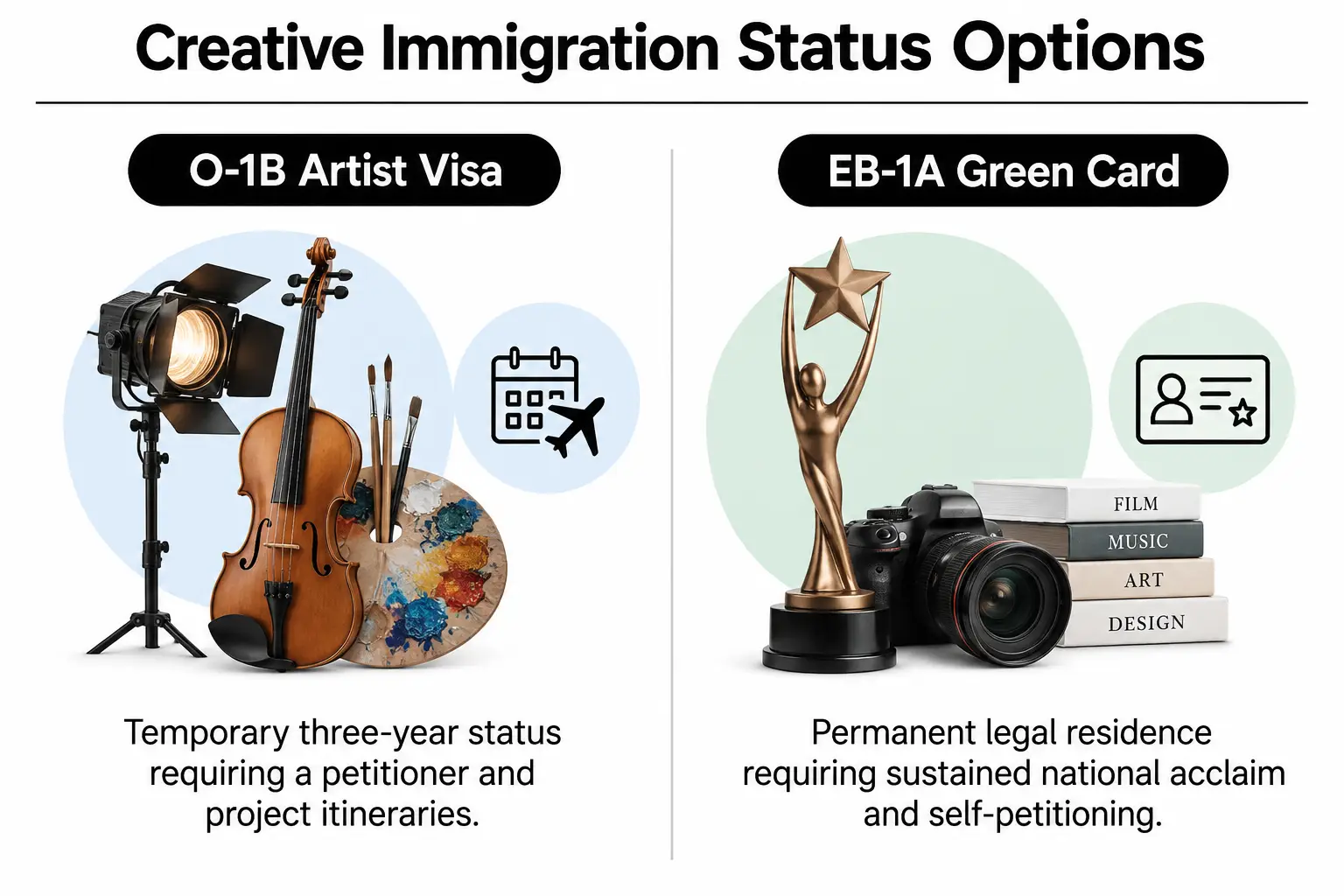
Comparing immigration options for creatives
|
Starting point |
Next filing to consider |
Evidence to review |
Intended effect |
|---|---|---|---|
|
F-1 STEM or arts OPT |
Move into an initial three-year O-1B artist petition. |
Assess published reviews of student showcases and other critical press coverage. |
Plan to avoid gaps in US work authorization while building a professional base. |
|
Active O-1B status |
Build a national profile toward a self-petitioned EB-1A filing. |
Check records of peer-review panels and festival judging, along with leading roles in distinguished projects. |
Work toward a green card without gaps in status. |
|
International touring performer |
P-1 status, followed by individual O-1B and eventually permanent status. |
Track solo billing and primary credits, plus reviews in recognized trade publications. |
Document individual extraordinary ability apart from the ensemble’s reputation. |
Moving from temporary work status to permanent residency requires attention to timing as well as evidence. Rule updates, including the DHS fixed-stay rule affecting student and exchange visas, matter for student creatives. We account for these developments when planning a move into independent production work without a lapse in status.
Gathering Bulletproof Evidence for USCIS Adjudicators
USCIS officers do not decide these petitions based on whether they like your art. They need verifiable evidence that meets the legal standards, including independent press and measurable achievements. Preparing that record for an O-1 or EB-1 petition usually means gathering documents carefully over several months, rather than assembling a portfolio just before filing.
-
Document major and critical roles: Gather contracts and event programs, along with promotional materials showing your leading or critical role for distinguished organizations.
-
Collect independent reviews: Keep newspaper profiles and trade reviews that discuss your own creative contributions. Coverage in specialized journals can also help document how others recognize your work.
-
Obtain required union consultations: Request advisory letters confirming your standing from the appropriate labor union, such as SAG-AFTRA, AFM or AGMA. Our guide explains AFM and AGMA consultation letters for singers.
-
Verify commercial or box office success: Collect records of sales, streaming figures, gallery receipts or festival admissions that support your claim of commercial acclaim.
-
Secure peer reference letters: Ask recognized authorities in the arts to explain what your contributions mean to the field, using specific examples and plain language.
Evidence rule: Praise from colleagues carries little weight without specifics. Reference letters need objective accomplishments and concrete examples of your impact across the industry.
Filing Costs, Premium Processing, and Budgeting for Success
Budget for government filing fees and union consultation costs, as well as legal representation. Knowing those expenses early helps you plan for an unexpected gig that may require faster processing.
|
Budget level |
What to prioritise |
What to question |
|---|---|---|
|
Standard tier ($) |
Basic USCIS filing fees for Form I-129 or I-140, plus required peer union consultation fees. |
Paying for premium processing when your production or gallery start date is more than five months away. |
|
Accelerated tier ($$) |
We assess whether USCIS premium processing fits your deadline and prepare the request where appropriate. |
Rushing to file before obtaining detailed, independent reference letters from recognized peers. |
|
Comprehensive tier ($$$) |
A dual-track plan: extending O-1B status while building the EB-1A record. |
Submitting uncoordinated petitions without counsel checking that evidence remains consistent across categories. |
Premium processing may be worth the cost if a New Jersey performance, tour opening or shoot leaves little time for review. For qualifying cases, Abachi Law LLC also offers money-back terms for O-1 and EB-1 representation. Review those terms as part of your budget, not as a promise of approval.
Common Questions About Creative Visas and Green Cards
What is an artist visa?
Usually, this means O-1B, a temporary visa for international creatives who can show distinction in their field. You need a qualifying US petitioner or agent, plus an itinerary of upcoming projects. Initial status may last up to three years. One-year extensions are available for ongoing engagements.
Can I get an artist visa usa without winning major awards like a Grammy or an Oscar?
Yes. Major entertainment awards are not required. Federal rules let you meet the evidence standard through at least three alternative criteria. These include significant critical reviews, leading roles for distinguished organizations, commercial success or pay that is high compared with your peers.
How does a us artist visa compare to a permanent green card for artists?
Temporary artist work authorization is tied to an approved itinerary and the petitioning agent or employer. An EB-1A green card for artists gives you permanent resident status that does not end with a particular gig. It allows self-petitioning without an employer and provides a direct route toward US citizenship.
Can creative professionals qualify for an eb1 architect green card?
Architects and structural design directors can qualify for EB-1A by proving extraordinary ability. Evidence may include significant recognized buildings, international competition results, major monographs or coverage in peer-reviewed trade publications. Reviewers assess these records under the general EB-1 science or business standards, rather than the usual fine-arts rules.
Is an eb1 green card for creative directors easier to get than an O-1B?
No. EB-1 requires sustained national or international acclaim and a discretionary final review of the record as a whole. Creative directors with extensive portfolios may have a strong O-1B case. For EB-1A, however, those records must show that they rank at the very top of their design field worldwide.
What makes talent-based visas different from a marriage based green card?
Talent-based petitions depend on your professional achievements and ongoing contributions to US arts and entertainment, rather than a personal relationship. A marriage-based green card depends on a valid marriage. Talent petitions offer independence from spousal sponsorship and base your residency case on your professional career.
Planning Your Creative Filing Strategy with Abachi Law LLC
At Abachi Law LLC, we help foreign performers, visual artists and production crew members plan filings around their work. Our focus is protecting creative careers across New Jersey and the greater metropolitan region as clients move toward permanent residency. Before choosing a petition route, we review these practical details:
-
Status review: Check how much time remains on your F-1, OPT, P-1 or O-1B status.
-
Petitioning sponsor: Confirm your agency agreement or an employer ready to sign Form I-129.
-
Portfolio verification: Review third-party documents supporting three distinct regulatory criteria.
-
Union consultation: Identify the peer labor union that represents your creative field.
-
Timeline planning: Compare regular USCIS backlogs with premium processing timeframes.
To have a local immigration lawyer review your portfolio and assess your filing options, contact Abachi Law LLC.
Legal disclaimer: This article is general information, not legal advice, and reading it does not create an attorney-client relationship. Laws change and differ from state to state, and past results do not guarantee a similar outcome. For advice about your own situation, speak with a licensed attorney at Abachi Law LLC.