

Answer a Notice of Intent to Deny (NOID) with evidence that directly addresses each reason USCIS gives for denying your extraordinary ability visa petition. The notice is a warning, not a final rejection. Our guide to writing useful testimonial letters for artists explains how those letters can support your response.
Unlike a Request for Evidence (RFE), a NOID means the reviewing officer has found that your submission falls short of federal standards. Your response must address the officer’s legal reasoning and correct any factual errors. It also needs objective documentary proof, submitted before the deadline.
At our firm, we represent international artists, touring performers, and creative founders across New Jersey and the greater metropolitan area. These notices call for more than personal praise. We focus on verified third-party evidence that addresses the disputed requirements under the governing federal regulation.
Each exhibit must connect your work to critical acclaim or commercial distinction.
What’s Inside This Guide
-
Direct Rebuttal vs. Petition Refiling vs. Premium Reapplication
-
Matching Your Defense Strategy to Your Specific Case Posture
Anatomy of an O-1 Notice of Intent to Deny
An officer reviewing an O-1 visa petition typically sets out the reasons for a NOID in a multi-page notice. It identifies the requirements your evidence did not meet and explains doubts about your sustained acclaim. Read those findings closely before deciding what documents to gather.
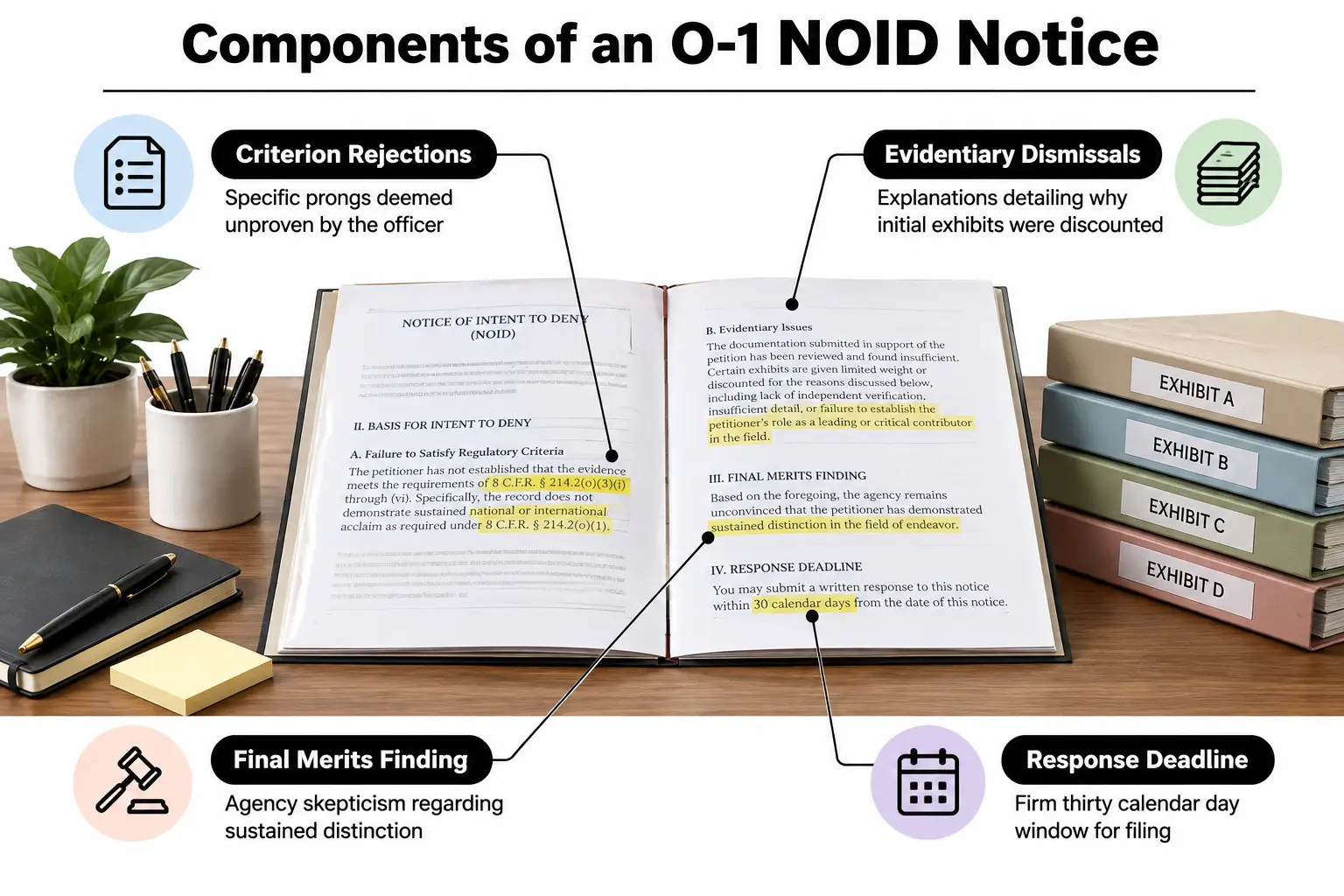
What an O-1 NOID contains
-
Specific Criterion Rejections: The officer identifies which three evidence categories you failed to establish, such as critical reviews, commercial results, or high pay.
-
Evidentiary Dismissals: These explain why documents were discounted, often because letters were vague or media coverage appeared promotional.
-
Final Merits Determination: This is the officer’s overall finding that your record lacks the required national or international distinction.
-
Strict Filing Window: The notice sets a firm deadline, generally around thirty calendar days. Federal regulations do not allow extensions.
O-1B petitions for fine arts and commercial work both draw close review of the evidence of distinction. Notices we see often question a publication’s reach or downplay the applicant’s role in major productions. Our legal insights offer more context on changes in how officers assess these cases.
Step-by-Step Response Strategy for Challenged Petitions
Sending the original packet again does not address the officer’s concerns. We start by comparing each finding in the notice with the exhibits in the original filing. That review helps separate evidence the officer overlooked from genuine gaps in the documents you submitted.
Next, your team gathers independent records to support the disputed claims. A challenge to commercial success calls for certified box office figures, royalty statements, or verified streaming data. Counsel then drafts a point-by-point response, citing binding agency decisions and the USCIS policy guidance for O-1 petitions.
The Evidentiary Bridge Most Applicants Overlook
More praise is a common response, but it often misses the problem. Five new generic recommendation letters will not fix a lack of objective evidence in a talent-based petition. Instead, provide data that shows why your existing achievements matter in your field.
Suppose the officer discounts coverage because it appeared in a regional publication. Supply independent circulation audits and readership details, along with editorial standards showing that it serves as a major trade publication. Our guide to supporting evidence explains how to make those connections in an O-1B filing.
Direct Rebuttal vs. Petition Refiling vs. Premium Reapplication
After a NOID, you need to decide whether to defend the current petition or change your filing approach. Compare the work and cost involved before committing to either route.
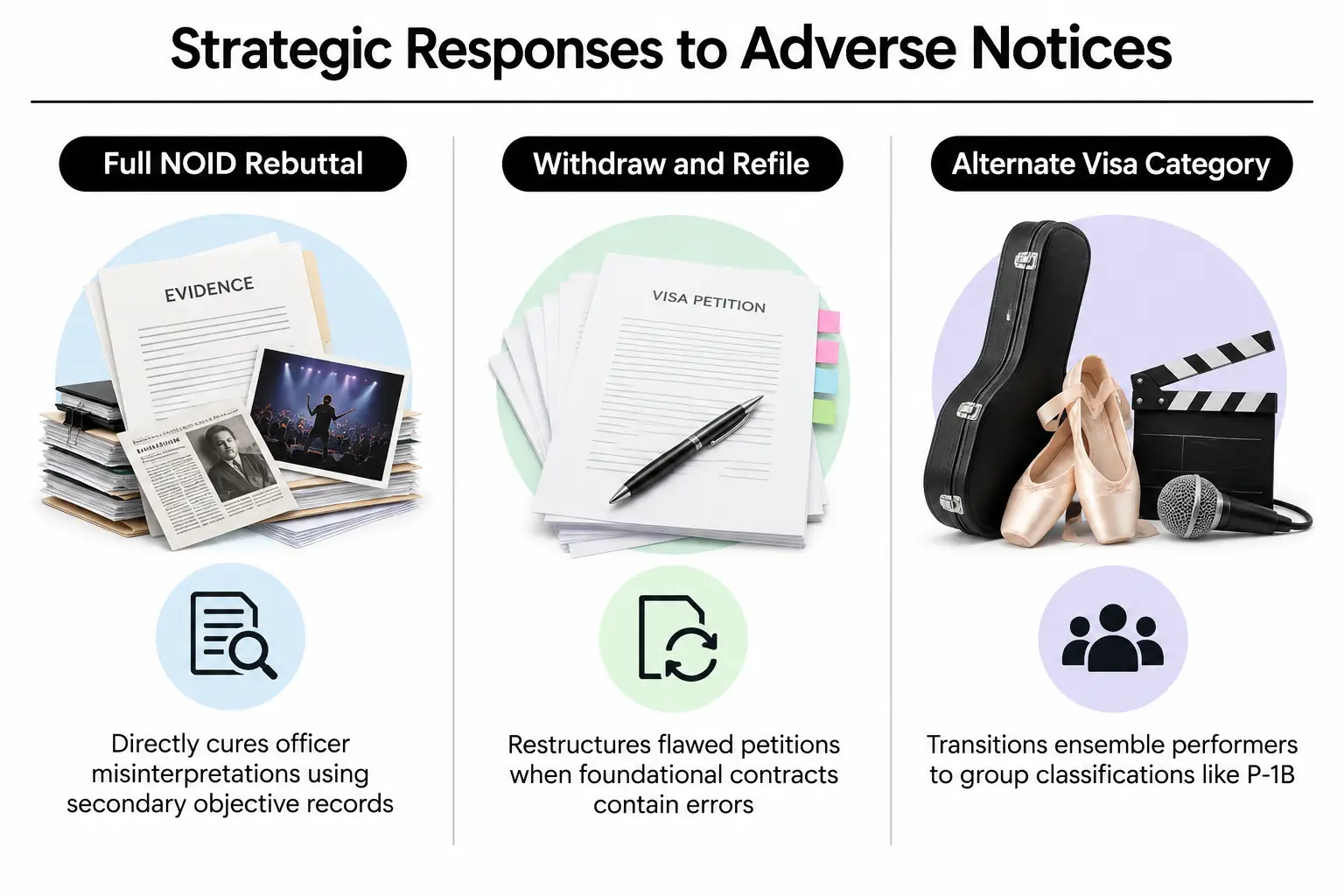
Ways to respond to an adverse notice
|
Strategy option |
Administrative work |
Outcome predictability |
Filing cost tier |
Best fit |
|---|---|---|---|---|
|
Full NOID response |
Detailed legal brief and new supporting data |
Moderate to high |
$$ |
Cases where the officer made a clear legal error or misunderstood key evidence |
|
Withdrawal and immediate refiling |
Rebuilding the petition from scratch |
Moderate |
$$$ |
Petitions with flaws in the itinerary, deal memos, or petitioner’s underlying status |
|
Refiling under another classification |
Preparing a case under different rules, such as P-1B |
High |
$$$ |
Ensembles or performers whose records better fit group standards than individual distinction |
Musicians and touring groups can face particular problems with individual filings. Working with an attorney handling P-1 visas to explore group options may make more sense than defending a flawed solo petition. That decision matters for your budget and travel schedule, so assess the underlying filing before spending time on a response.
Three Tactical Approaches to Rebutting Adjudicator Doubts
The right legal argument depends on why the officer rejected your evidence. Review the following approaches with an O-1 visa attorney who can connect the objections to specific documents and legal standards.
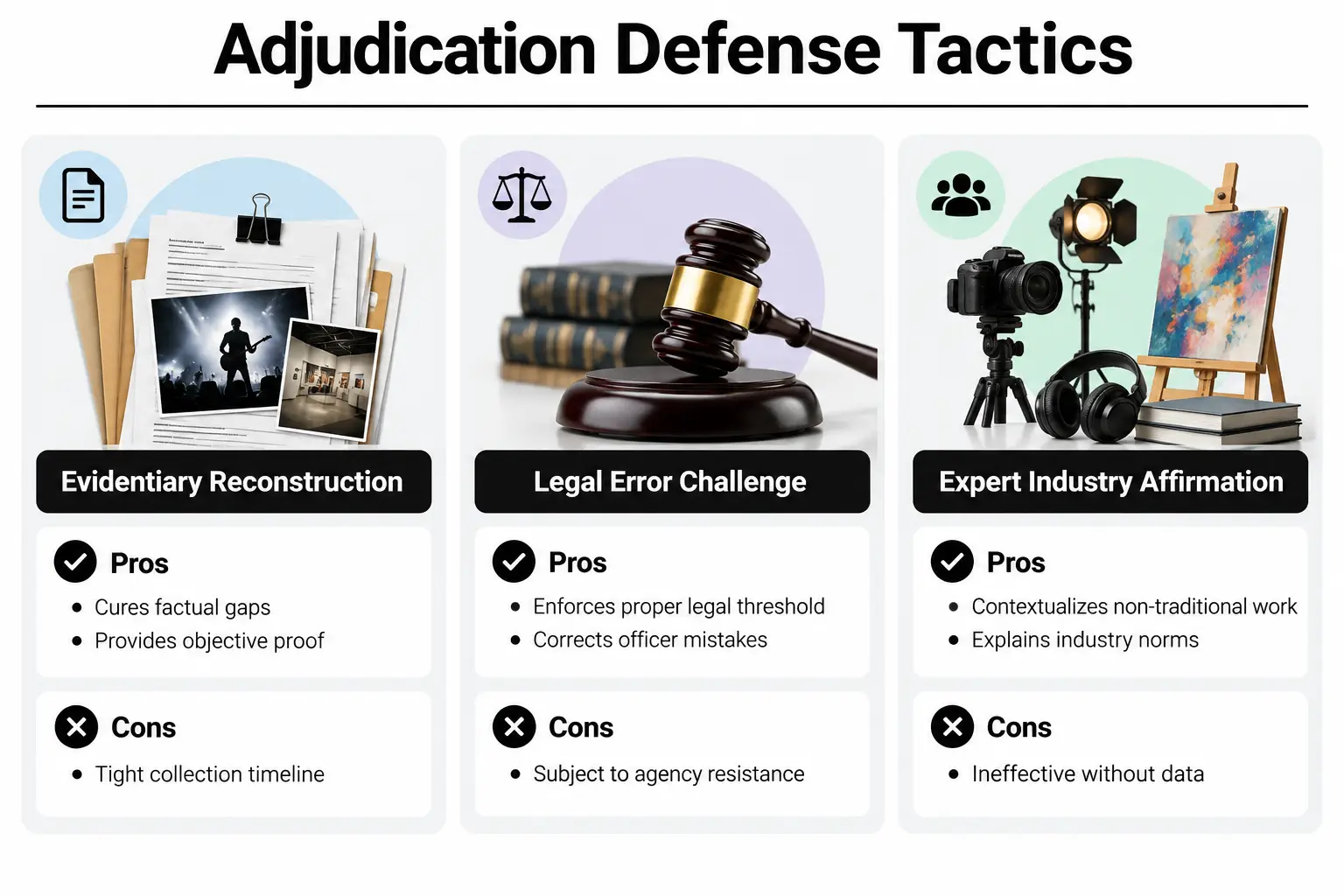
Arguments and evidence for a NOID response
-
Evidentiary Reconstruction: Gather certified supporting records, box office statements, and independent trade data to back up disputed claims.
Main benefit: Addresses missing factual support without changing the petition’s legal basis.
Main drawback: Getting third-party records requires close coordination within a short deadline. -
Legal Error Challenge: Show that the officer used the higher EB-1A standard rather than the distinction standard that applies to arts petitions.
Main benefit: Calls for USCIS to assess the evidence under the correct legal standard.
Main drawback: The officer may still find the overall record unpersuasive despite the legal argument. -
Expert Industry Affirmation: Obtain opinion letters from established union leaders or prominent industry figures who can explain acclaim in a specialized field.
Main benefit: Connects less traditional creative work to recognized professional standards.
Main drawback: Letters carry little weight if they lack supporting records or read like templates.
Singers, instrumentalists, and composers often face close scrutiny of their critical acclaim. For musicians’ U.S. visa filings, we connect performance reviews to national tour attendance and verified streaming figures. To discuss how those records fit your case, reach out to our team for a review of your options.
Matching Your Defense Strategy to Your Specific Case Posture
Different creative careers leave different paper trails. Your field and existing contracts shape the response, but the specific reasons in the notice should guide which records you collect.
|
Applicant situation |
Suggested response |
Key risk to avoid |
What to keep doing |
|---|---|---|---|
|
Commercial fine artist |
Submit independent auction records and critical gallery coverage |
Relying on self-published exhibition catalogs |
Documenting sale prices and the gallery’s standing |
|
Independent filmmaker |
Provide festival rankings and verified streaming distribution records |
Treating minor unpaid online screenings as major venues |
Tracking verified viewership and licensed sales |
|
Freelance tech designer |
Use client data to show your work’s critical effect on user adoption |
Vague reference letters without project data |
Keeping product release records and signed client contracts |
|
Touring stage performer |
Supply contract deal memos and peer group advisory clearances |
Gaps in your multi-city performance itinerary |
Securing peer reviews and venue booking confirmations |
Counsel’s Check: Treat every stated defect as something your response must address with verifiable third-party records. Leaving objections unanswered risks a final denial and complications for future talent petitions.
A sound response starts with understanding the O-1B requirements. Artists who move between commercial engagements and experimental projects also need to check that their underlying contracts meet immigration rules.
Protecting Your Status After Submitting the Response
Submitting the response does not end the need to monitor your immigration status. Pay close attention to timing if your current authorized stay is about to expire.
Immediate Audits to Conduct Following Submission
-
Courier Delivery Confirmation: Track delivery to the correct service center and check the recorded receipt date against the notice’s deadline.
-
Status Expiration Monitoring: Check whether existing approvals still authorize you to work or whether you need to pause professional work.
-
Petitioner Communication: Keep your agent or employer informed about processing updates so they can adjust booking calendars.
-
Contingency Filing Preparation: Review longer-term options, including consulting an EB-1 visa lawyer about permanent residency if your circumstances change.
Agent-filed petitions need carefully prepared itineraries. Our guide to the petitioner’s role explains the arrangements to review when checking that your representation still meets the requirements.
Questions Creators and Attorneys Ask About O-1 NOID Notices
How does a NOID differ from a Request for Evidence?
With an RFE, USCIS asks for clarification or missing basic documents. A NOID says the agency has reviewed your evidence and found that the petition does not meet legal requirements. It is the final formal warning before a denial notice.
Can I request an extension to answer an O-1 NOID?
No. Federal immigration regulations do not allow extensions for NOID responses. The complete legal brief and supporting exhibits must reach the designated USCIS service center before the deadline printed on your notice.
Is it better to withdraw my petition instead of answering?
Withdrawal may make sense if the original filing has fundamental flaws, such as an invalid petitioner or missing consultation letters. But if the officer misread your achievements or overlooked strong evidence, a detailed response preserves the existing filing fees and original priority.
Can I introduce completely new projects in my NOID reply?
Generally, achievements or contracts that arose after the original filing cannot establish eligibility for that petition. Your response must show that you qualified on the date USCIS received the petition, rather than through work completed later.
Do new recommendation letters fix an adjudicator’s objections?
Letters help only when they explain specific technical facts or interpret data the officer questioned. General praise without references to verifiable media coverage or financial records will not resolve an adverse finding.
Securing Your Case with Abachi Law LLC in New Jersey
At our New Jersey law firm, we represent performers, visual artists, and creative founders responding to agency challenges. We review artistic achievements against the federal standards USCIS applies, then prepare a defense tied to the evidence. Our work focuses on the specific objections in your notice and the records available to answer them.
-
Reviewing the officer’s factual and legal objections line by line.
-
Checking media coverage, box office records, and industry data against the regulatory requirements.
-
Drafting legal briefs supported by evidence and relevant agency policy.
-
Reworking agent or employer-petitioner contracts to address potential itinerary disputes.
-
Explaining procedural deadlines and the steps needed to maintain lawful status.
Please contact our team to schedule a detailed review of your immigration notice and the evidence needed for your response.
Legal disclaimer: This article is general information, not legal advice, and reading it does not create an attorney-client relationship. Laws change and differ from state to state, and past results do not guarantee a similar outcome. For advice about your own situation, speak with a licensed attorney at Abachi Law LLC.