
For most foreign bands touring New Jersey, P-1B is the starting point, with an experienced U.S. agent filing the petition. These talent-based visas require evidence that the band has sustained international recognition as an established group.
Member changes, solo projects, or gaps in working together over the past twelve months can change that assessment. Our post on o-1 and eb-1 petitions explains related filing options.
Bookings at Asbury Park music halls or Newark arenas require immigration paperwork before the band takes the stage. Unclear petitioner arrangements and unverified tour dates can lead to denials and canceled shows. For a separate immigration policy topic, see our discussion of the proposed fixed-stay rule.
What’s Inside This Guide
- The Real Hazards of Filing Band Visas Without Legal Structure
- Picking Your Filing Route: Ensemble Standing Versus Individual Acclaim
- Matching Your Tour Lineup to the Right Visa Class
- Aligning Tour Contracts, Venues, and Union Consultations
- Actionable Steps to Build an Ironclad Band Petition
- Allocating Your Tour Legal and Filing Budget
- Common Legal Questions for Touring Bands
- Plan Your New Jersey Performance Itinerary Confidently
The Real Hazards of Filing Band Visas Without Legal Structure
Tour schedules leave little room to fix filing mistakes. Rushed paperwork can mean refusal at the border, followed by breached venue contracts and losses across several cities. Promoters and festival organizers also face compliance penalties if they let foreign acts perform without the required authorization.

Bands sometimes underestimate the proof required by the USCIS P-1B guidelines. Solo artists rely on their own acclaim; ensembles must document the group’s reputation. Disorganized press clips or unverified streaming figures can prompt a Request for Evidence (RFE), a formal request for more documentation that can put opening night at risk.
Practical check: Hold off on non-refundable flights and ticket announcements until you have your petition approval notice or formal visa interview appointments.
At Abachi Law LLC, we organize evidence of your work around the legal requirements officers review. Our team checks booking agreements across the region for issues that could disrupt the schedule.
Picking Your Filing Route: Ensemble Standing Versus Individual Acclaim
Comparing Group Recognition and Solo Distinctions
Start by deciding if the act should file as a group or seek individual classification for its lead performers. P-1B covers entertainment groups with sustained international recognition. By contrast, an o visa for artists applies to an individual with extraordinary ability in the arts.
| Filing Route | Recommended Starting Point | What to Watch |
|---|---|---|
| P-1B entertainment group | An established band with a stable lineup and international press under its shared name | Requires 75 percent of the group to have performed together for at least one year |
| O-1B solo artist with support | A prominent frontperson touring with session players or backing performers | Backing musicians must qualify separately under O-2 essential support rules |
| P-3 culturally unique artists | Traditional folk ensembles and other acts performing cultural heritage or ethnic world music | Requires proof of cultural authenticity rather than commercial chart success |
An established band will usually find P-1B the simpler filing route because the evidence concerns the group, rather than each member’s credentials. A lead singer with separate solo releases may need a different approach. An attorney handling artist petitions can assess whether separate group and individual petitions make sense.
Matching Your Tour Lineup to the Right Visa Class
Permanent band members rarely make up the entire touring party. Sound engineers and lighting technicians travel with the act, as do tour managers and sometimes substitute drummers. Support crew need their own filings; they cannot simply be added to the band’s standard P-1B petition.
| Touring Personnel | Recommended Choice | Avoid |
|---|---|---|
| Core band members (over 1 year in the group) | P-1B classification under the group petition | Filing individual O-1B petitions without a reason |
| New session musicians (under 1 year in the group) | P-1B with the twenty-five percent statutory exemption | Claiming they have played in the band for years |
| Essential crew (audio, lighting, tour manager) | P-1S essential support personnel visa | Entering on standard B-1/B-2 visitor status |
| Solo guest performers | Individual O-1B or standalone P-1 status | Including unaffiliated artists in the band’s filing |
Tour manager rule: Essential support crew must show critical skills and prior experience with the band. Their duties must be work that local stagehands cannot readily handle.
Putting crew or guest artists in the wrong category creates serious immigration risks. Technical crew entering on visitor visas to operate soundboards violate federal labor rules and may be removed at the border. A P-1 visa attorney can review each person’s duties and identify the filing needed for that role.
Aligning Tour Contracts, Venues, and Union Consultations
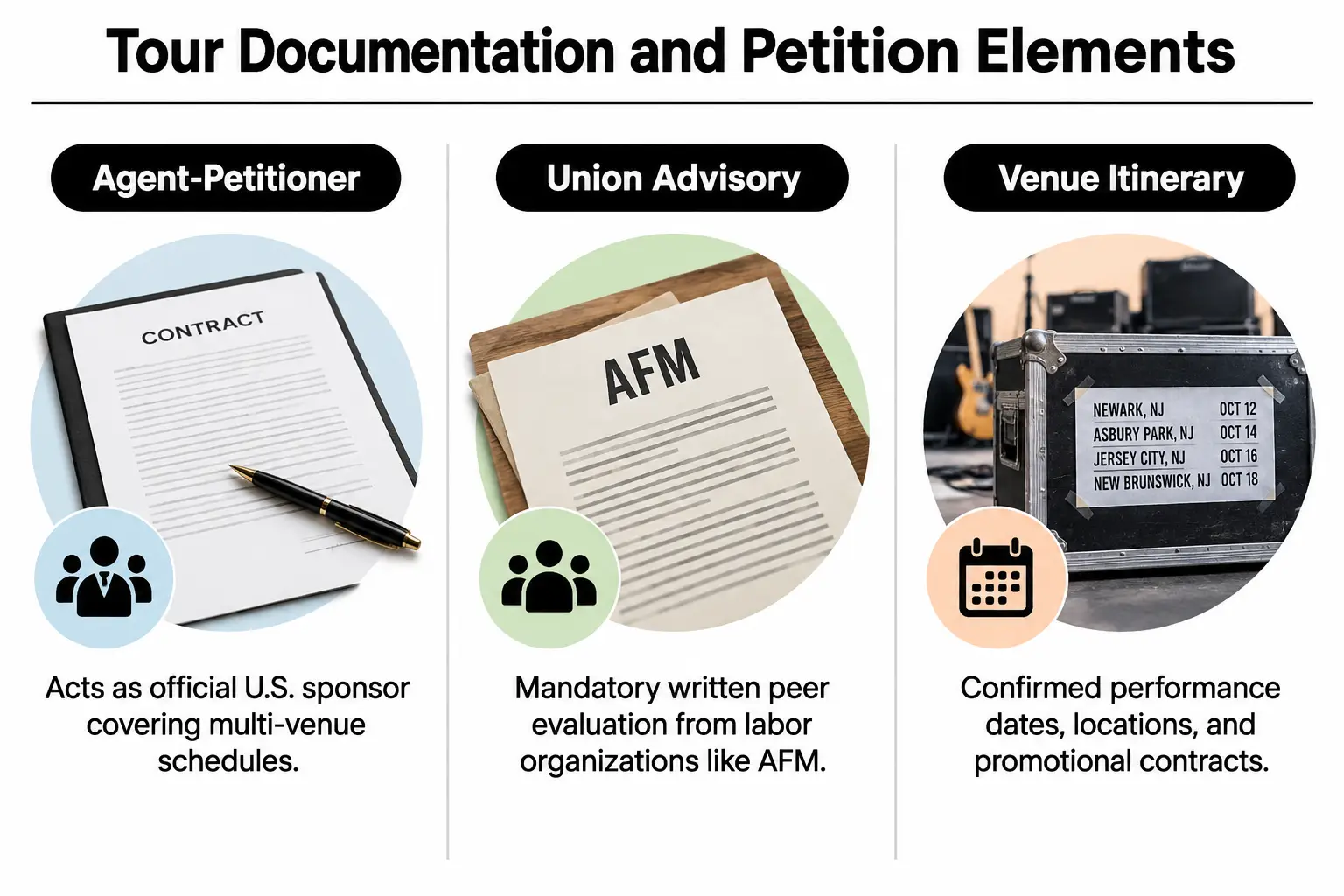
Your U.S. petitioner needs to coordinate with venues and labor organizations before filing. Foreign bands rarely have one permanent U.S. employer, so an authorized agent-petitioner is an important part of the arrangement. Our explanation of who can file a talent visa petition covers how a booking agency or management firm can act on your behalf.
| Starting Point | Pairing Direction | What to Sample or Test | Intended Effect |
|---|---|---|---|
| Multi-venue tour itinerary | U.S. agent-petitioner filing | Contracts and deal memos, backed by venue confirmation letters | Documents the full schedule without separate petitions for each club |
| Union peer review letter | American Federation of Musicians (AFM) | Tour history and press kits, along with the group’s recorded releases | Provides the required advisory opinion on the group’s international standing |
| Festival appearances | Main performance schedule | Promoter agreements and lineup announcements | Establishes the dates supporting the requested temporary stay |
Before submitting Form I-129 to USCIS, the band must obtain an advisory opinion from the American Federation of Musicians. That letter is a required step in the filing process. Our guide to planning a tour under P-1B rules explains how to put the itinerary together.
Actionable Steps to Build an Ironclad Band Petition
We begin assembling a petition early, so there is time to collect records and coordinate with everyone involved. Each part of the file needs documentary support:
- Document the band’s history: Gather old performance flyers and album credits, along with social media announcements. These records should show that the core lineup has worked together for at least twelve continuous months.
- Collect commercial evidence: Compile streaming figures that can be verified, physical sales receipts, chart records, and substantial reviews from major industry publications. Keep the supporting records with each claim.
- Prepare the full itinerary: Obtain signed contracts or detailed deal memos for every stop. Include Montclair club dates and Jersey City festivals, as well as theater bookings in New Brunswick.
- Request the union consultation: Send the completed file to the appropriate labor organization, such as AFM or AGMA. The organization reviews the materials and provides the required written advisory opinion.
- File Form I-129 with USCIS: Submit the complete petition to the designated federal service center. Use premium processing when the first performance falls within several weeks of filing.
Evidence check: USCIS reviews the group’s reputation as a whole. Awards earned by one member do not automatically prove that the band has international standing.
Unexpected delays or questions from a consulate may require further documentation. An entertainment visa immigration lawyer can review those inquiries and prepare responses using the records in your file.
Allocating Your Tour Legal and Filing Budget
Set aside funds for federal filing fees as well as legal work. Union review costs also belong in the tour budget. Choosing an unverified low-cost service can leave the band facing much larger losses if filing problems force shows to be canceled.
| Budget Level | What to Prioritise | What to Question |
|---|---|---|
| Core compliance ($) | Standard USCIS filing fees and required union advisory review costs | Services offering approval without an official union consultation |
| Accelerated timeline ($$) | USCIS premium processing fees for an initial response within fifteen calendar days | Last-minute services claiming they can secure consular interview appointments |
| Full tour management ($$$) | Legal work on multi-venue compliance and crew filings, plus consular preparation | Business immigration firms without experience handling entertainment industry filings |
Premium processing often makes sense for bands with fixed rehearsal dates. A shorter wait for an initial USCIS response can help promoters plan marketing and merchandise production. It does not remove the risk of delays or last-minute cancellations.
Common Legal Questions for Touring Bands
Can our foreign band perform at open-mic nights or showcases without a visa?
No, foreign musicians need appropriate work authorization to perform in the United States, even without a performance fee. A live appearance has promotional and commercial value. Federal immigration rules treat that activity as unauthorized work for someone in visitor status.
What happens if our drummer joined the band less than a year ago?
Federal rules allow up to 25 percent of the performers to be exempt from the one-year association requirement in specific circumstances. These can include replacing someone because of illness or an unexpected departure. Counsel can formally request the statutory exception in the petition and supply the supporting documents.
Can a band enter the U.S. on a B-1 visa just to record in a New Jersey studio?
Yes, musicians may use B-1 visitor status solely to record at a U.S. studio if the music will be distributed outside the country. No public live performances may take place during that visit. Commercial gigs, including paid showcases and ticketed events, require petition-based status such as P-1B or O-1B.
How does long-term residency work for musicians entering on talent visas?
P-1B and O-1 visas authorize temporary work, but accomplished performers often consider permanent residence as a separate step. Our guide to self-petitioning for permanent residence explains how evidence from an established artistic career can support an EB-1A petition.
Plan Your New Jersey Performance Itinerary Confidently
At Abachi Law LLC, we help international bands and other performers address the immigration requirements behind their New Jersey bookings. That work includes coordinating the legal paperwork with the practical demands of a tour.
Before committing to the performance schedule, check that these items are in place:
- Confirmed dates and written performance contracts for every venue
- Records showing that 75 percent of the lineup has performed together for twelve months
- An authorized U.S. agent-petitioner designated to file
- Performance materials submitted to the AFM for peer review
- Detailed resumes and job descriptions for essential support crew
To review your tour dates and filing requirements, contact our team to schedule a legal consultation.
Legal disclaimer: This article is general information, not legal advice, and reading it does not create an attorney-client relationship. Laws change and differ from state to state, and past results do not guarantee a similar outcome. For advice about your own situation, speak with a licensed attorney at Abachi Law LLC.