
The main I-9 audit risks when hiring foreign performers involve how you classify the work and document permission to perform it.
Legal help is generally needed for unusual guest contracts, official audit notices, or visa petitions covering several venues. Those issues can affect international directors as well as performers. For routine domestic hires with standard identification, your human resources team can usually complete the paperwork without outside counsel.
Timing and worker classification often determine where a theater’s records fall short. Calling overseas talent independent contractors to avoid work authorization forms can expose the venue to substantial liability. New Jersey production teams need to understand how federal employment verification rules apply before rehearsals begin, not after an inspector requests their files.
What’s Inside This Guide
- Evaluating Legal Representation for Production Audits and Guest Visas
- The Legal Workflow for Onboarding International Performers
- Selecting Counsel for Creative Talent Petitions and Compliance
- Key Questions to Pose During Your Compliance Consultation
- Warning Signs When Reviewing Immigration Counsel
- Enforcement Realities and Agency Jurisdiction in New Jersey
- Common Inquiries Regarding Theater Hires and Visa Audits
- Protecting Your Theater Season with Abachi Law LLC
Evaluating Legal Representation for Production Audits and Guest Visas
Each season brings different staffing demands, from casting local ensembles to booking international headliners. Not every hiring task calls for a lawyer. Some situations, though, carry enough risk that your production team should get legal advice before moving ahead.
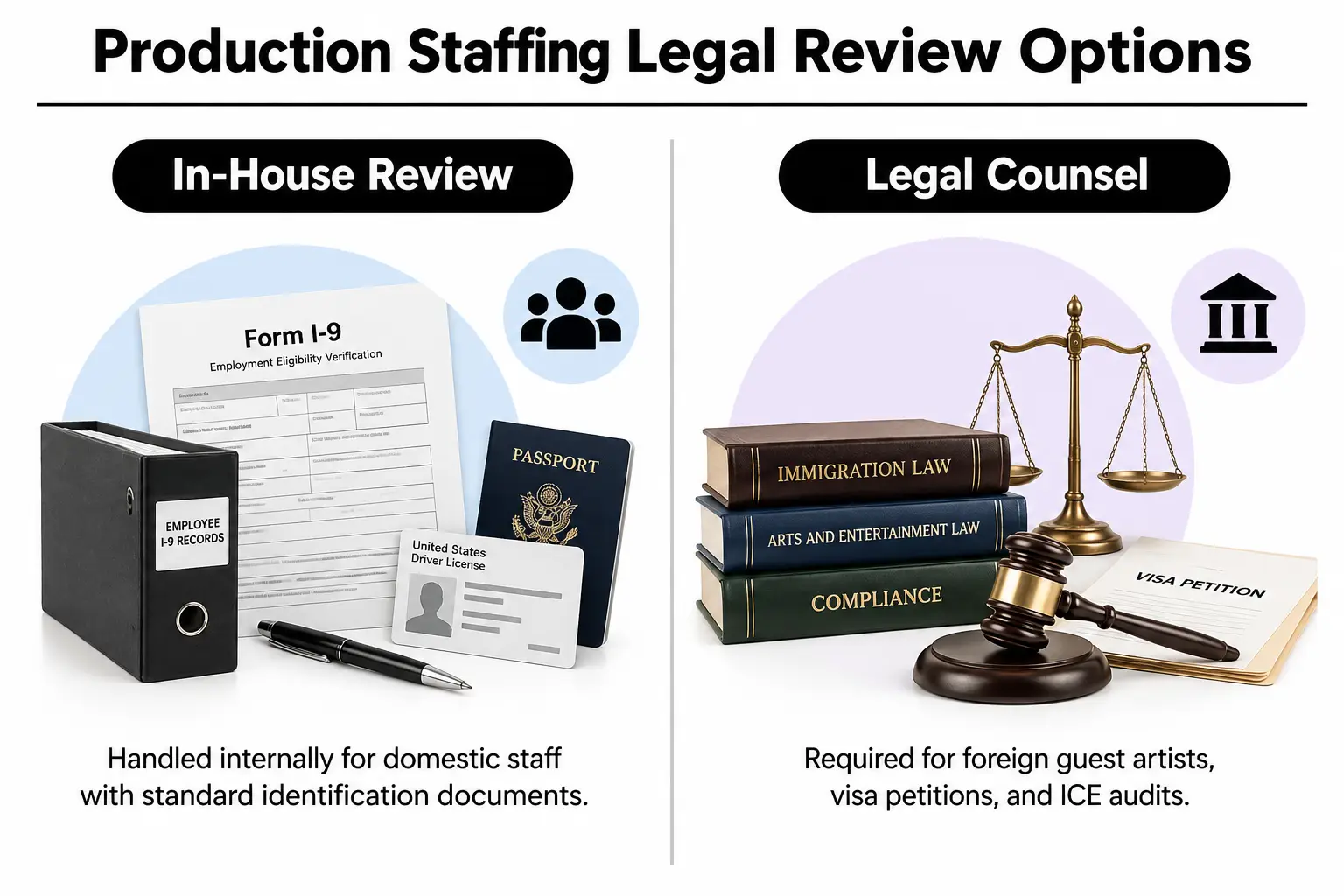
For venues in Newark, Princeton, and Red Bank, one common difficulty is identifying who must file the artist’s petition. That question gets harder when a freelance entertainer has bookings with several employers.
Federal inspectors review employment eligibility records against specific technical rules, even when a contract seems clear to the production team. Reviewing who acts as the petitioner and defining employment status early can help administrators avoid penalties tied to guest artist records.
| Production situation | Lawyer recommended? | Reason for review |
|---|---|---|
| Hiring local box office staff and stagehands as W-2 employees | No | Routine domestic hiring documents generally follow verification steps your internal team can handle. |
| Receiving an ICE Notice of Inspection (NOI) for employment records | Yes | A strict 72-hour deadline applies to producing files, and technical errors can lead to fines. |
| Booking international guest soloists on temporary artist visas | Yes | Petition dates must match the agent’s filed itinerary and the documents used to verify employment eligibility. |
| Moving an international artist from F-1 optional practical training (OPT) to an ensemble contract | Yes | A review helps identify gaps in work authorization that could leave the performer unable to rehearse legally. |
| Hiring foreign talent through an international management agency | Depends on the facts | Counsel reviews contract terms, including who bears liability, to determine whether the agency or theater must verify eligibility. |
Freelance work does not always fit neatly into U.S. Citizenship and Immigration Services (USCIS) petition requirements. An early review can save time when bookings span several projects. Our initial visa assessment tools can help your team consider how much legal help it needs before booking deadlines pass.
The Legal Workflow for Onboarding International Performers
Production immigration work extends beyond preparing forms. An attorney handling O-1 visas or P-1 petitions can coordinate the artist’s filing with the theater’s employment verification duties. Both need attention, even if different people on your team manage booking contracts and personnel records.
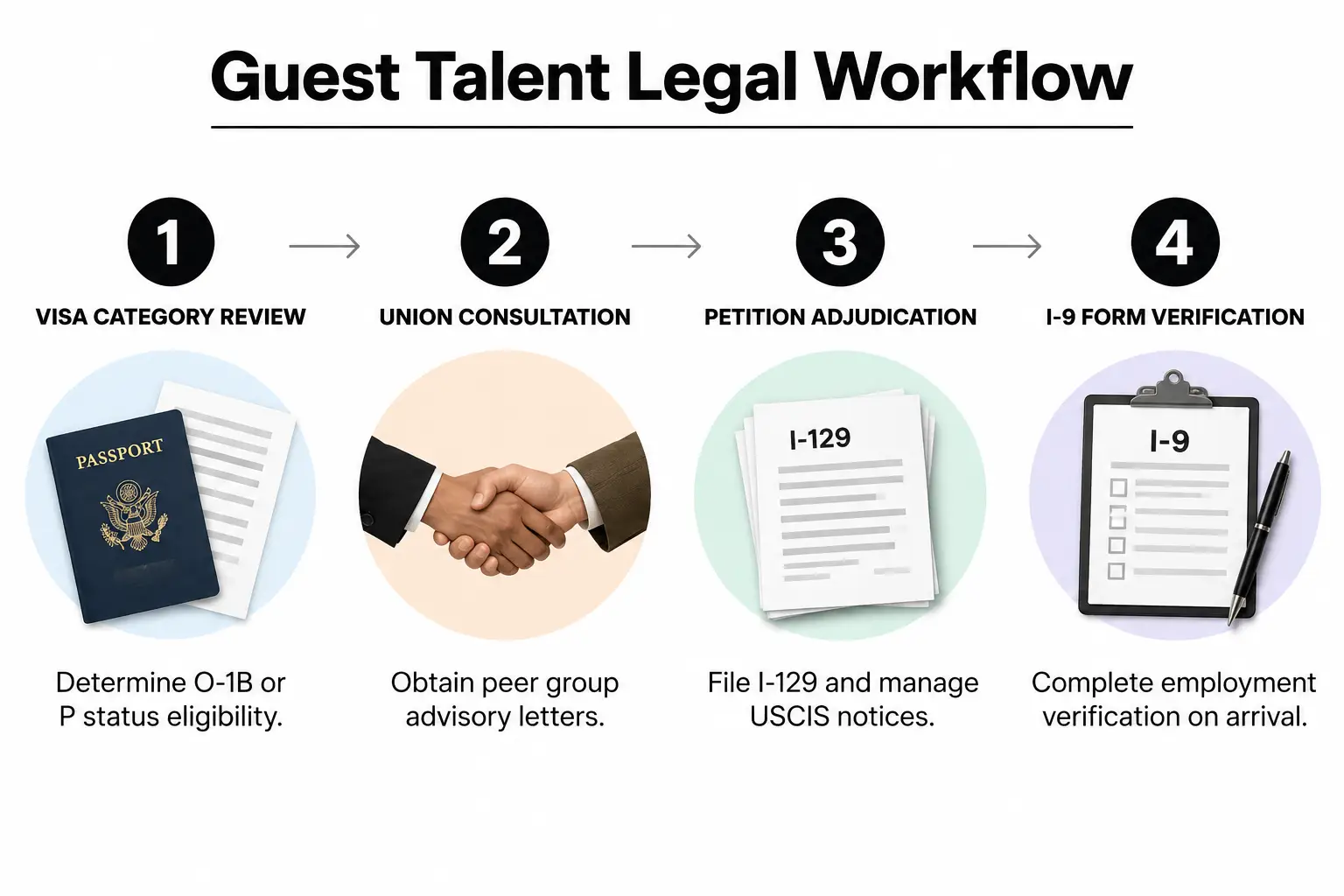
- Review the engagement and visa category: Counsel determines which category fits the planned work and who should file the petition. Options may include an O visa for artists, such as O-1B, or P-1 status for a group.
- Gather union letters and supporting evidence: The legal team helps obtain required consultation letters from peer groups and unions, including SAG-AFTRA, AFM, or AGMA. Counsel also reviews evidence of extraordinary ability when an artist lacks mainstream awards. The goal is to address USCIS requirements through the artist’s available record.
- File the petition and address agency questions: Your lawyer submits Form I-129 to the immigration agency and tracks processing. Counsel also responds to a Request for Evidence (RFE) or Notice of Intent to Deny (NOID). Either may question the evidence of artistic acclaim or international recognition.
- Review support personnel: Counsel checks whether accompanists or technical staff need related filings. This can include reviewing O-2 support visa requirements for foreign film crews and how support categories apply to theater productions.
- Set up employment verification: After the artist secures entry, counsel guides administrators through Section 2 of Form I-9. That includes checking when work authorization must be verified again, so an expired document does not go unnoticed during rehearsals.
Coordinating these steps helps address border processing gaps that could interrupt a production and damage the venue’s reputation.
Selecting Counsel for Creative Talent Petitions and Compliance
Look for experience with entertainment work, not simply a general immigration practice. Artistic portfolios need a different kind of review from routine employment files. A lawyer must understand what the evidence shows and how to present it under USCIS rules.
Direct Experience with Arts and Entertainment Categories
Immigration practices may handle anything from family cases to corporate transfers or asylum. For theater work, seek a lawyer who understands visas for touring music groups and production deadlines. Reviews and festival appearances can matter, as can performance programs. Counsel needs to explain how those materials support the required legal showing.
Transparent Fee Structures and Service Scope
Arts budgets leave little room for unclear fees. Your engagement agreement should separate the cost of a compliance audit from individual visa petition fees. Ask whether the quote includes responses to routine agency questions. Find out, too, whether an RFE would require another retainer before the lawyer starts that work.
Clear Communication Across Rehearsal Timelines
Missed deadlines can leave a stage dark and season ticket holders expecting refunds. Ask how your attorney will communicate and what deadlines apply to union letters and government decisions. A production team needs updates it can plan around, rather than weeks without a response as opening night gets closer.
Verifying Standing and Credentials
Check that the attorney holds an active license in good standing. New Jersey theater boards can consult the Supreme Court of New Jersey Attorney Online Registration and Payment Center or relevant state bar associations. Licensing records help you check professional standing. They do not establish how an attorney will handle your matter or what its outcome will be.
Key Questions to Pose During Your Compliance Consultation
Use the consultation to ask how counsel would handle your actual bookings and records. For O-1 audit preparation or guest engagements, these questions can help you assess the proposed work:
- How often do you handle talent petitions rather than general employment cases? Entertainment cases rely on artistic portfolios and evidence that may rarely appear in a corporate filing.
- Does your advice cover both the petition and our Form I-9 records? An O-1B visa does not settle every question about how the venue must document work authorization after arrival.
- How do you approach cases without conventional industry awards? Ask how counsel evaluates regional reviews and prominent roles, along with other evidence of critical acclaim, against extraordinary ability requirements.
- What happens if tour dates or venues change during production? Counsel should explain when an amended petition is required and how a change could raise questions about authorized employment.
- Can you help obtain required labor advisory opinions? Ask about working with entertainment unions such as AGMA, AFM, and Actors’ Equity, including the process for requesting their letters.
- How do you handle itineraries covering several venues? Your theater may need an attorney familiar with agent-petitioners, who file for guest talent performing at several regional arts centers.
- How will you respond to an urgent Request for Evidence? Find out who gathers the materials and manages the response deadline when delays could threaten the performance schedule.
Before committing your season’s budget, contact us about reviewing your records and the legal work your theater may need.
Warning Signs When Reviewing Immigration Counsel
Take time to review a proposed engagement, even if a booking deadline is close. These practices should give your theater reason to pause:
- Promises that a petition will be approved or that an audit carries no risk, contrary to professional ethics rules.
- Refusal to provide a written engagement agreement that sets out filing and advisory fees.
- Advice to label foreign guest artists as unpaid volunteers to avoid work authorization paperwork.
- Little familiarity with performing arts union consultation bodies or their usual response times.
- Pressure to pay a retainer immediately, before anyone has reviewed the artist’s credentials.
Check before rehearsals: Confirm that the artist’s immigration classification permits work at your venue before they begin. Trying to fix I-9 records afterward can expose the theater to substantial risk during a federal review.
Long-term planning may also involve moving from temporary O-1 or P-1 status to permanent residency through an EB-1A self-petition. Ask prospective counsel about that work if a permanent role is under consideration. Our guide to EB-1A extraordinary ability petitions explains more about this option for artists.
Enforcement Realities and Agency Jurisdiction in New Jersey
Several federal agencies oversee different parts of a New Jersey theater’s immigration obligations. Federal immigration enforcement through U.S. Immigration and Customs Enforcement (ICE), part of the Department of Homeland Security, handles I-9 audits. After a Notice of Inspection, companies generally have three business days to produce original verification records for current and recently departed employees.
USCIS decides visa petitions through its service centers. The Department of Labor monitors wage rules for certain performing classifications. Northeast corridor venues need consistent records because site visits may occur without warning. Counsel familiar with entertainment schedules and federal audits can help teams prepare to produce historical employment files when investigators request them.
Common Inquiries Regarding Theater Hires and Visa Audits
Can a theater pay a foreign artist an honorarium without an employment visa?
Generally, no. A standard visitor visa usually does not permit an honorarium for services in a ticketed public performance. Nonprofit cultural venues must check that the performer holds an appropriate classification, such as O-1B or P status, before paying compensation or reimbursing production expenses.
How do i-9 audit risks when hiring foreign performers affect non-profit regional theaters?
Nonprofit status does not reduce the statutory civil fines for missing or inaccurate forms. The same rules apply to commercial producers. Failing to verify work authorization within the required three-day window can lead to fines for each violation, regardless of the theater’s tax-exempt status.
Are guest soloists considered independent contractors exempt from Form I-9?
A contractor label alone does not settle the issue, especially if your theater controls rehearsals, staging, and artistic presentation. ICE can examine the actual working relationship. If it finds that the venue misclassified an artist to avoid verification, the theater faces direct liability for employing unauthorized workers.
What visas are appropriate for visiting singers and musicians?
Solo singers and instrumentalists typically seek O-1B visas based on extraordinary ability. Ensembles usually pursue P-1B entertainment group visas. Production managers should consult a lawyer handling EB-1 visas or entertainment immigration matters to assess whether individual or group status fits the planned work.
Does a music festival require a compliance audit service for foreign headliners?
An immigration compliance review helps festival organizers check petition approvals and travel endorsements for touring acts before arrival. Reviewing these records before the festival can help address issues that might lead to entry refusals. It also helps organizers prepare their files for an on-site agency inspection.
Protecting Your Theater Season with Abachi Law LLC
At Abachi Law LLC, we advise theaters and performing arts companies on talent visas and employment verification. We also work with international creative professionals. Our work includes complex O-1 and EB-1 extraordinary ability petitions, along with reviews of organizational records to identify compliance gaps that may matter in an audit.
During an initial consultation, attorney Shervin Abachi reviews your production schedule and contracts alongside the guest artists’ portfolios. That review helps define the legal work needed for your upcoming season. To discuss your bookings and compliance records, schedule a confidential consultation with us.
Legal disclaimer: This article is general information, not legal advice, and reading it does not create an attorney-client relationship. Laws change and differ from state to state, and past results do not guarantee a similar outcome. For advice about your own situation, speak with a licensed attorney at Abachi Law LLC.