
Freelancers can meet O-1B visa requirements without a single corporate employer, but they need an organized schedule of planned work, not possible gigs. For independent entertainers and production talent in New Jersey, a U.S. agent petitioner can support work with multiple employers when the petition includes the required agreements, itinerary, and agency authorizations. This structure supports qualifying freelance arrangements, and meets USCIS nonimmigrant worker guidelines, but it does not provide unrestricted work authorization.
Your field affects how you build the case. For someone working in both UI design and visual fine art, the case must explain how the proposed duties fit the requested O-1 classification. Gaps in a performance calendar can also shorten an approval period if the event dates are not firmly set.
What’s Inside This Guide
-
Picking Your Sponsorship Structure: Employer Versus Agent Petitioner
-
Aligning Non-Traditional Achievements with Regulatory Criteria
-
Pairing Gigs, Peer Advisory Opinions, and Deal Documentation
-
Allocating Resources: Filing Costs, Translations, and Rush Processing
The Real Cost of Freelance Gaps in Creative Petitions
Working gig to gig across New Jersey often means moving between regional playhouses and commercial recording spaces, with independent design commissions in between. That schedule makes sense in the arts. Federal officers, though, review your application against strict timelines.

Reviewing creative contracts and gig calendars
Gaps between bookings do not automatically limit an O-1B approval to the first engagement. USCIS considers whether the documented activities support the requested period, which can be up to three years for an initial petition. Explain significant gaps and how the engagements relate to the overall project or series of activities.
Vague emails and undocumented commitments can leave USCIS unable to confirm the planned work and may prompt an RFE. A written contract is useful, but USCIS also accepts a written summary of an oral agreement showing the terms offered and accepted.
Practical check: An agent-based petition needs evidence of actual planned work. Use written contracts, deal memos, or summaries of oral agreements that document the agreed terms.
Unsupported calendars can delay productions right away. A denial or shortened stay can force venues to cancel engagements, costing them money and interrupting the artist’s immigration status.
Picking Your Sponsorship Structure: Employer Versus Agent Petitioner
Evaluating Petition Frameworks for Independent Artists
Choosing a petitioner defines the work arrangements covered by your O-1B petition. A direct employer petition generally covers work for that employer, including qualifying assignments it undertakes for its clients. An agent petition can cover multiple employers when properly documented. Separate employment outside the approved arrangements generally requires another petition or an amendment.
|
Option |
Recommended Starting Point |
What to Watch |
|---|---|---|
|
Direct single employer |
In-house animators, resident gallery directors, agency staff writers |
Separate employment for another employer generally requires another petition or an amendment. Client assignments through the approved employer may be covered. |
|
U.S. agent as employer |
A U.S. individual or business that genuinely acts as the artist’s employer |
Requires proof that the agency actually hires the artist, rather than serving as an intermediary on paper. |
|
U.S. agent for multiple employers |
Freelancers, touring musicians, independent actors, interdisciplinary designers |
Requires the itinerary, employer agreements, and agency authorizations applicable to the arrangement. |
For independent professionals seeking an artist visa, the multi-employer agent structure offers the most flexibility. It can cover several documented employers in one filing. Later engagements must remain within the authorized arrangements or be covered by an appropriate additional filing. Your filing can account for work with several employers rather than just one.
Aligning Non-Traditional Achievements with Regulatory Criteria
Distinction does not require a Grammy or an Academy Award. Regulations allow other proof of significant national or international acclaim, such as major media reviews, leading roles in distinguished events, or commercial success. The harder task is turning digital and independent creative achievements into evidence an officer can assess.
|
Situation or Style |
Recommended Choice |
Avoid |
|---|---|---|
|
Indie musician / touring artist |
Streaming analytics, tour receipts, critical album press, curated festival lineups |
Relying on social media follower counts alone, without independent press coverage. |
|
Hybrid UX / creative technologist |
Using arts standards with design gallery showings, app awards, and press coverage |
Relying on artistic labels when the actual proposed duties are primarily software development. Classification must match the work. |
|
Independent filmmaker / actor |
Independent festival honors, distribution agreements, trade publication features |
Relying on credits alone without evidence of the production’s reputation, your role, or recognition of your achievements. |
O-1B visa requirements differ between the arts and motion picture or television productions. Independent filmmakers and actors working in qualifying screen productions generally must meet the motion picture or television extraordinary-achievement standard, with its separate consultation requirements.
Start by reviewing the formal O-1B criteria against your professional record. Documents from your industry must show sustained national or international acclaim. How you present that record matters: the officer needs evidence of recognition, not just a list of completed projects.
Counsel’s rule: Viral reach is not the same as critical acclaim; officers look for recognition from established publications and recognized industry professionals.
Compensation records need context, too. If relying on the high-compensation criterion, compare your actual or proposed pay with reliable compensation data for others doing comparable work in the field. Earning more than entry-level workers alone does not establish this criterion.
Pairing Gigs, Peer Advisory Opinions, and Deal Documentation
Most O-1B petitions require a written consultation from an appropriate consulting source, subject to applicable exceptions and waivers. Arts cases may use an appropriate U.S. peer group, labor organization, or qualified expert. Motion picture and television cases generally require consultations from both the relevant labor and management organizations. Submission materials and fees depend on the consulting organization.
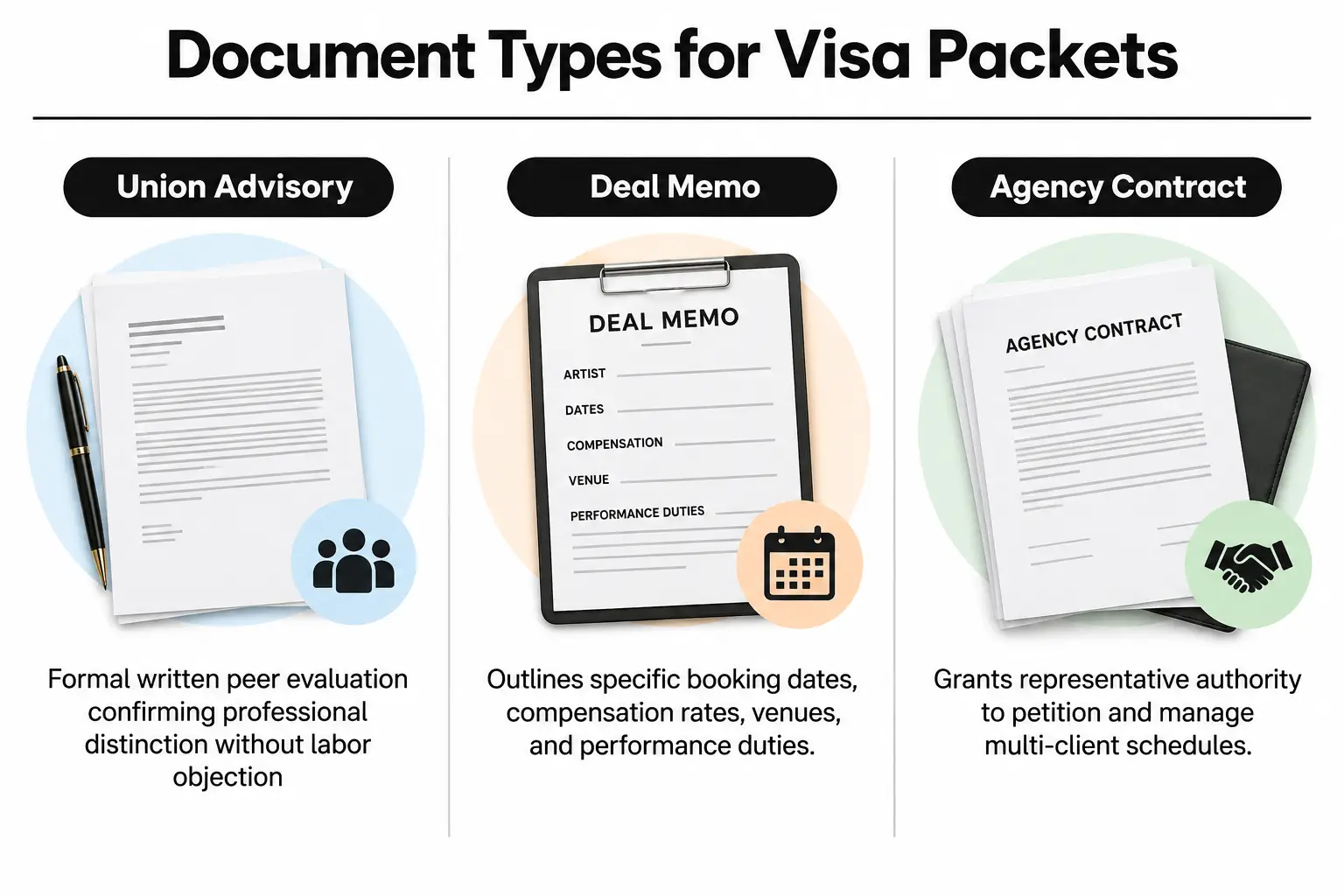
Documents for a visa filing
Organizations such as SAG-AFTRA, the American Federation of Musicians, and IATSE provide advisory opinions for relevant occupations. A letter of no objection does not itself establish O-1B eligibility, and USCIS makes the final decision.
|
Starting Point |
Pairing Direction |
What to Sample or Test |
Intended Effect |
|---|---|---|---|
|
Union peer consultation |
Union for the specific artistic craft (e.g., AFM, SAG-AFTRA) |
Read the union’s submission rules for exact fees and document requirements |
Obtains the applicable advisory opinion, which may express no objection to approval. |
|
Deal memo / engagement contract |
Signed letters of intent or performance agreements |
Confirm that payment, location, dates, and duties are spelled out |
Shows genuine artistic employment rather than possible work. |
|
Agency representation agreement |
Contract establishing the petitioner’s authority |
Check for express authority to file petitions and manage bookings |
Meets federal agency rules for representing multiple employers. |
Advisory letters take advance planning. Unions have specific submission procedures, so send your portfolio well before filing with USCIS to obtain a letter of no objection. Before signing with a sponsor, review our explanation of how petitioners work in talent-based nonimmigrant visas. It explains the agent’s role in the filing.
Building an Airtight Multi-Venue Itinerary Step by Step
A well-organized itinerary helps document the O-1B approval period you request, up to three years for an initial petition. Build the record of upcoming work from the actual bookings, then check that each supporting document agrees with the calendar:
-
Write detailed deal memos: Include your exact role, agreed pay, performance dates, and venue location in each document.
-
Sign the representation contract: Set out your agent’s authority to act as petitioner for bookings with multiple clients.
-
Request peer advisory letters: Send the proposed calendar and supporting evidence to the appropriate labor organization for its advisory letter.
-
Gather supporting letters: Ask industry leaders to explain your contributions to earlier high-profile projects.
-
Put bookings in date order: Show every engagement chronologically to document continuous employment without substantial gaps.
Adjudication rule: Testimonial letters should explain your personal contribution and its impact, rather than repeat the credits on your resume.
Our guide to testimonial letters for arts petitions explains how to request useful support from respected industry figures. Well-written letters give officers context for press clippings and awards. They help explain what those records show about your work.
Allocating Resources: Filing Costs, Translations, and Rush Processing
Budget for the required filing fees as well as the cost of preparing evidence. Keeping those expenses separate makes it easier to decide where to spend and whether a rush fee is necessary:
|
Budget Level |
What to Prioritise |
What to Question |
|---|---|---|
|
Baseline filing (mandatory fees) |
Core USCIS form fees and required union consultation review payments |
Paying for premium processing before gathering all supporting documents. |
|
Mid-tier (evidence gathering) |
Certified translations of international press and trade articles, plus portfolio preparation |
Spending on general publicity campaigns that do not establish artistic distinction. |
|
Accelerated tier (short deadlines) |
USCIS premium processing when filming or tour dates leave little time |
Paying union rush fees when regular review schedules fit your timeline. |
Careful evidence preparation produces better results than rushing an incomplete filing. Organizing the records early also helps avoid stressful requests for more information later. For a broader look at putting these materials together, read our guide to preparing an artist visa application.
Common Evidentiary Inquiries for Garden State Performers
Can a personal manager serve as my O-1B agent petitioner?
Yes. A personal manager or booking representative operating in the United States can petition as an agent for bookings with multiple employers. That representative can be an individual or a business. Include an agency agreement authorizing them to act for you, plus the contracts from your booking venues.
What should I do if an engagement falls through after my visa is approved?
Minor schedule changes need not invalidate your status if you keep working in your recognized artistic field within the petition’s scope. Substantial changes to your plans are different. If those plans change significantly or you switch managing agents, you generally need an amended petition to stay compliant.
How can creative technologists demonstrate eligibility under O-1B standards?
Creative technologists and user experience designers must place their work within the fine or commercial arts, rather than pure software development. Gallery displays and interactive installations can help, as can visual design awards. These records support review under the arts standard instead of the higher academic benchmarks used for sciences.
Do deal memos have to be fully executed long-form legal contracts?
No, informal deal memos can meet the rules if they include the key terms of the engagement. Describe the project and give the service dates and specific work locations. State the pay that both parties have agreed to, rather than leaving compensation open.
Structuring Your Filings with Abachi Law LLC
At Abachi Law LLC, we help independent talent prepare documents that meet federal filing requirements. Our work covers creatives staging productions in Red Bank, exhibiting in Jersey City, or running studio sessions across northern New Jersey. Before working with our firm on a submission, use this checklist to assess what you have ready:
-
Confirm that supporting records cover at least three distinct evidence criteria.
-
Prepare an organized itinerary with signed deal memos for upcoming projects.
-
Identify a suitable United States agent or entity willing to sign as your petitioner.
-
Obtain formal consultation letters from the relevant union or peer organizations.
-
Gather media articles, critical reviews, and testimonials from industry professionals documenting your career.
Contact our team to schedule a review of your portfolio and upcoming bookings.
Legal disclaimer: This article is general information, not legal advice, and reading it does not create an attorney-client relationship. Laws change and differ from state to state, and past results do not guarantee a similar outcome. For advice about your own situation, speak with a licensed attorney at Abachi Law LLC.