For P-1B eligibility, at least 75 percent of a group’s performers must have been integral, continuous members for at least one year. The group must also be internationally recognized. These requirements come from federal immigration law and apply to international ensembles planning a United States concert tour.
This threshold keeps established musical groups from serving as temporary hiring halls for foreign talent whose qualifications have not been reviewed. Booking agents and artists need records that prove the one-year relationship. Missing evidence can lead to petition denials, costly Form I-9 employment verification audits, or canceled shows in New Jersey and across the country.
What’s Inside This Guide
The Statutory Blueprint of the 75 Percent Standard
P-1B status is for foreign groups recognized internationally as outstanding over a sustained period. Under 8 CFR 214.2(p)(4), United States Citizenship and Immigration Services (USCIS) looks at the group’s reputation. An individual musician’s success does not take the place of evidence about the band as a whole.
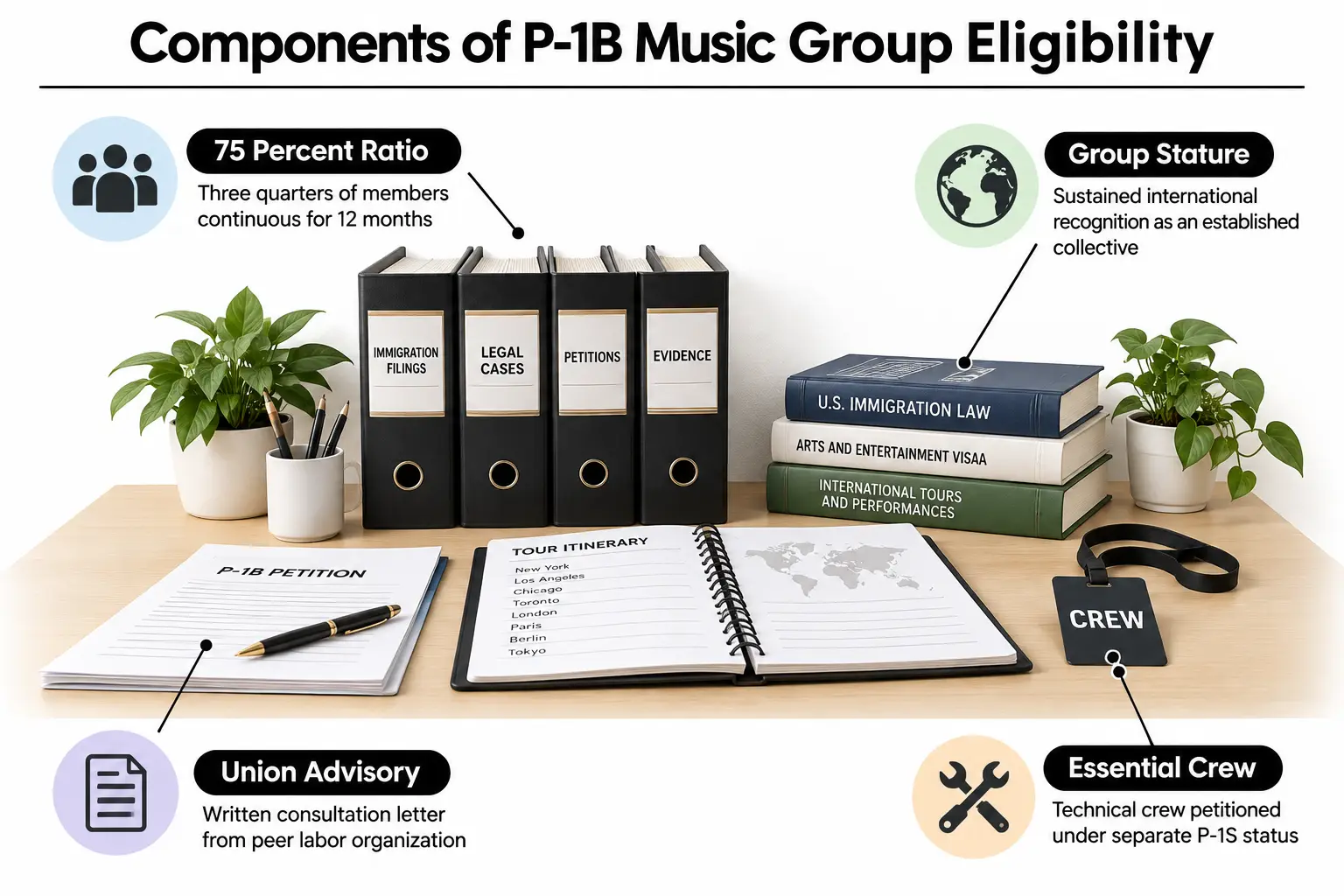
Components of P-1B Music Group Eligibility
Through our general immigration services, we help touring ensembles check their membership ratios against the evidence required for a petition.
-
Continuous membership: At least 75 percent of the artists must show a substantial, ongoing relationship with the group. That relationship must cover at least 12 continuous months before filing Form I-129.
-
International recognition: Evidence must show the group’s sustained public acclaim and international standing. Major reviews, chart rankings, or commercial releases can help document that reputation.
-
Essential support staff: Production workers, audio technicians, and stage managers file separately under P-1S support status. They do not count toward the 75 percent calculation for performers.
-
Mandatory union consultation: Petitions need written advisory opinions verifying group credentials from designated labor organizations. One example is the musicians’ union, the American Federation of Musicians.
An overseas entity may also need to decide between an O-1 agent petitioner and an employer-sponsor. The petitioner is the party that files the immigration petition. Reviewing the rules for that role can clarify who represents the artists before the group starts gathering its records.
Band Member Classifications Under Federal Evaluation
USCIS reviews each person on a touring roster. Core instrumentalists have different requirements from temporary substitutes or musicians who only contribute in the studio. Getting those roles wrong can trigger immigration compliance audits or substantial workplace fines under federal labor rules.
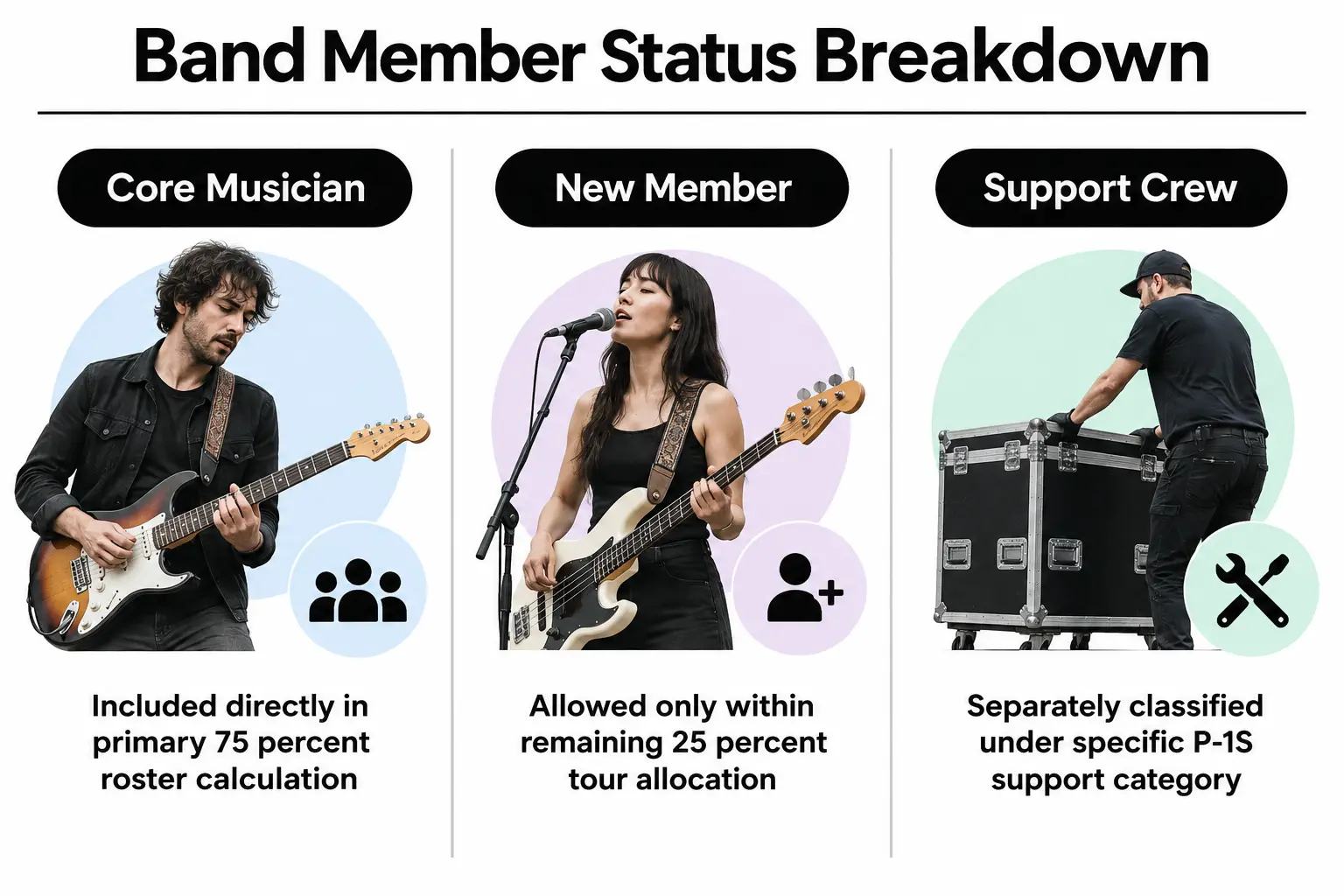
Band Member Status Breakdown
|
Situation |
Generally Covered? |
Why / Exceptions |
|---|---|---|
|
Core ensemble musician with two years of touring |
Yes |
Meets the continuous one-year requirement and counts toward the qualifying 75 percent. |
|
Session keyboardist hired three months ago |
Conditionally |
Can fit within the remaining 25 percent allowance, unless emergency substitute rules apply. |
|
Solo headliner with rotating backing musicians |
No |
Solo performers must seek individual O-1B status; backing players cannot file as a P-1B ensemble. |
|
Audio engineer or lighting designer traveling with the band |
Separate status |
Must file under P-1S support status and cannot count as a P-1B performer. |
Festival organizers handling complex bookings often request a compliance audit to check each worker’s authorization. The same care matters for groups traveling through regional hubs. Your documents need to match the people who will actually work on stage, rather than an earlier version of the touring roster.
Critical Exemptions to the One-Year Tenancy Standard
Live performances do not always go as planned, and USCIS recognizes that. Although the membership standard is strict, the law allows limited waivers when a group can document the circumstances.
Emergency Replacement of Key Personnel
A sudden illness, travel restriction, or unavoidable personal emergency may require a group to replace an established member. USCIS allows a waiver even if the replacement has not belonged to the group for a full year. The substitute must fill a critical performance role that the ongoing tour needs.
National Acclaim in Geographically Isolated Regions
Specific provisions allow USCIS to waive international recognition and one-year requirements for certain groups with a distinguished national reputation. These provisions address countries facing severe geographic or cultural isolation. The exemption is rare, but it allows culturally distinctive ensembles to perform abroad despite having limited records of international touring.
Circus Personnel Protections
Federal immigration law exempts foreign circus personnel from both the one-year membership requirement and the international recognition rule. The circus group must still be recognized nationally as outstanding. Its individual performers do not need to meet the 75 percent calculation.
Common Misunderstandings That Derail Performing Ensembles
Confusion about work authorization and visa categories regularly disrupts plans for overseas groups entering the country. Check the rules before filing. A petition submitted too soon can leave a group facing an expensive tour delay.
-
Myth: A B-1 visitor visa covers guest vocalists. Using visitor visas for ticketed public concerts violates federal work authorization laws. Promoters risk serious employer penalties if they misclassify foreign artists to avoid filing the required petitions.
-
Myth: Set list or venue changes never need paperwork. Substantial itinerary changes or unscheduled venue stops may require a formal petition amendment. Review those changes before the affected performances take place.
-
Myth: A band’s trade name qualifies a solo artist. P-1B status is only for groups. An individual must show extraordinary ability through a separate category such as O-1B, covered by our immigration services. Artists considering permanent options can also review EB-1 eligibility rules.
-
Myth: Stage crew belong on the band’s P-1B form. Technical crew need a separate P-1S petition. Supporting evidence must show why local workers cannot immediately replace their essential skills.
Responding to Denials, RFEs, and Form I-9 Inquiries
A Request for Evidence (RFE) asks you to supply more information about your petition. That notice, or an on-site inquiry from federal officers, needs prompt and careful attention. A rushed reply without supporting records can lead to a formal denial.
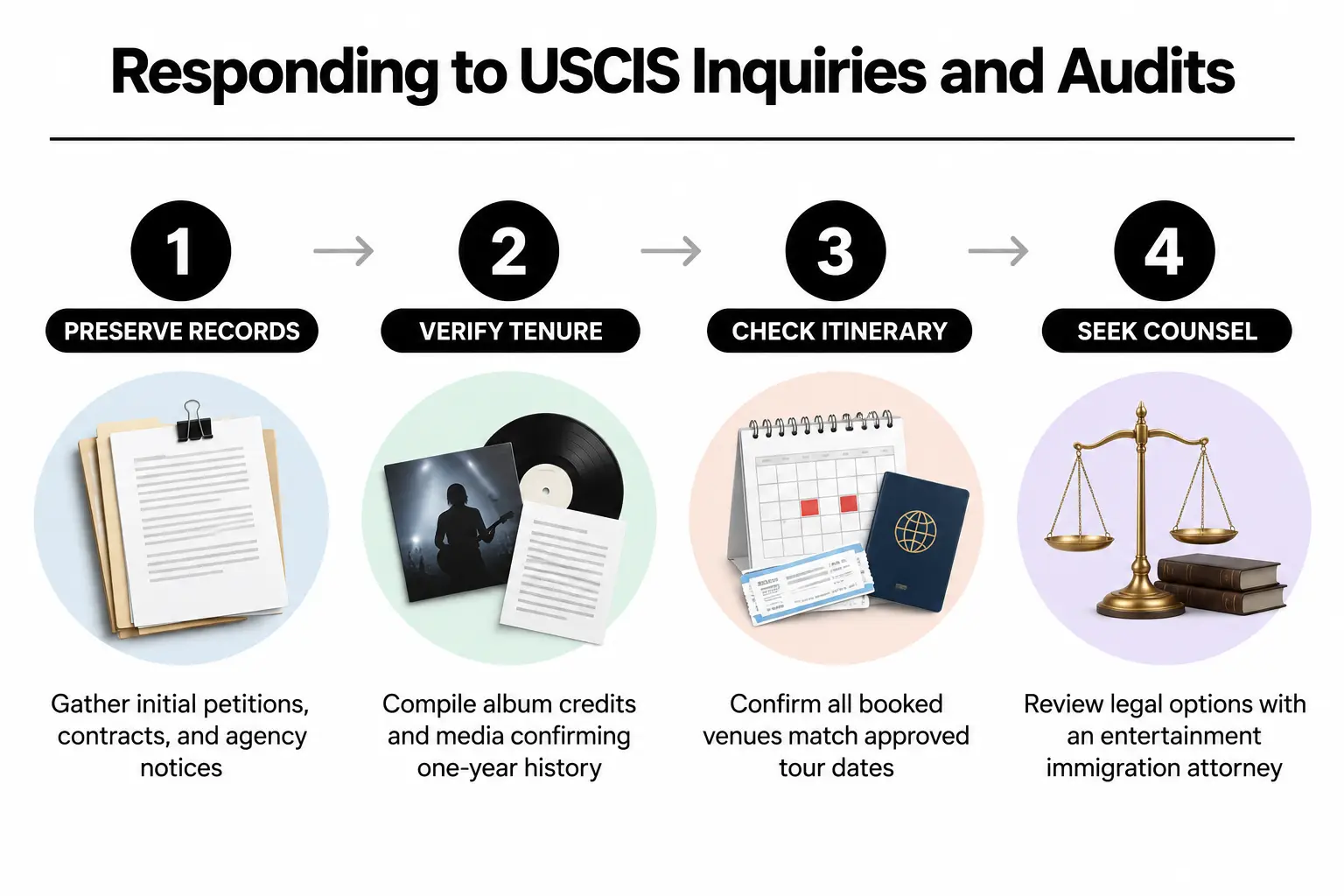
Responding to USCIS Inquiries and Audits
-
Keep all filing records: Gather complete copies of Form I-129 and its supporting contracts. Include advisory opinions and date-stamped USCIS receipt notices.
-
Check membership records: Collect album credits, royalty statements, festival programs, and media interviews. These records must prove at least one year of membership for 75 percent of the performers.
-
Compare contracts and itineraries: Check current tour stops against the itinerary in the approved petition. Confirm whether amendments for any location changes are still pending.
-
Review Form I-9 records: Make sure venue operators and domestic agents have correctly completed employment eligibility verification for all traveling production personnel.
-
Get a legal review: Ask an entertainment immigration lawyer to identify missing evidence and prepare a formal response addressing the government’s concerns.
Protect your claim: After an adverse notice, do not change tour dates, contracts, or member rosters before reviewing petition amendment rules with your lawyer.
Independent artists often have several performance dates to manage across state lines. Getting legal help with freelance performance bookings can prevent filing mistakes as you work through those separate gig arrangements.
Jurisdictional Boundaries and New Jersey Performance Bookings
Immigration law is federal, so USCIS service centers apply the same criteria wherever a tour begins. State rules still affect the practical work of putting on shows. Groups playing Newark, Atlantic City, or Red Bank often work with domestic production companies that must follow complex booking regulations.
Touring groups booking mid-Atlantic halls often need to compare agent and employer petitions for multiple venues. An agent can file a petition covering several New Jersey venues under one itinerary. That structure avoids having multiple employers file duplicate petitions for the same tour.
New Jersey venues also often enforce strict payroll requirements, so classifying foreign guest artists correctly helps avoid state employment disputes.
Direct Answers on P-1B Ensemble Qualifications
Can a newly formed supergroup qualify under the 75 percent rule?
No, a new ensemble generally cannot qualify even if all its members are internationally famous. The law looks at the group’s reputation and continuous history together. Success in each member’s earlier solo career does not replace that shared record.
What happens if our band drops below the 75 percent threshold before the tour?
Member departures can leave a band below the required ratio and ineligible for P-1B status. An emergency substitution waiver may apply. Otherwise, the group may need to restructure its petition or have a lawyer review other immigration options before the tour.
Are union consultation letters mandatory for P-1B filings?
Yes, USCIS will reject or delay petitions filed without an advisory opinion from an appropriate labor organization. Musical groups routinely obtain this consultation from the American Federation of Musicians. Another appropriate collective bargaining unit may also provide it.
How can independent creatives confirm options if P-1B does not apply?
Artists who do not meet the group requirements often consider individual categories such as O-1B or other immigration options for creative work. You can schedule a case review so we can assess which alternatives may fit your qualifications.
Legal Guidance for Touring Groups at Abachi Law LLC
At Abachi Law LLC, we focus on talent-based and general immigration services for international performers and recording artists, as well as production teams. We review membership records against the filing requirements. That means checking who is on the roster and preparing the documents needed to support the petition.
Our firm reviews your tour structure to reduce regulatory risks before they affect your bookings. We provide that guidance for musicians and other creative professionals, including theatre companies planning performances.
To review your upcoming performance schedule with us, contact our office.
Legal disclaimer: This article is general information, not legal advice, and reading it does not create an attorney-client relationship. Laws change and differ from state to state, and past results do not guarantee a similar outcome. For advice about your own situation, speak with a licensed attorney at Abachi Law LLC.