You can qualify for permanent residency through talent-based visas in the employment-based first preference category without an Oscar, Grammy, or Pulitzer.
For most creative professionals, the path starts with meeting at least three of the ten criteria in federal immigration law. The next step is proving sustained national or international acclaim during the final merits review, when USCIS weighs the record as a whole.
Without a major one-time prize, your case depends on the depth of your supporting documentation. Routine press releases and casual photos from gigs will not carry that burden.
Your field and your role determine which records matter most. Sound designers leave different commercial and critical records than lead singers or visual artists. Evidence that shows competence rather than distinction can lead to a Request for Evidence or denial from United States Citizenship and Immigration Services. Organizing your archive early helps address those weaknesses before filing.
What’s Inside This Guide
The Real Hurdle: The Two-Step Kazarian Standard
Some petitioners treat EB-1A review as a checklist, assuming three checked boxes are enough. Officers actually review the petition in two stages. That framework comes from the Kazarian court decision and appears in the agency’s policy manual.

Reviewing creative petition records
First, officers check whether the documents satisfy three of the ten criteria under 8 CFR 204.5(h). They then make a final merits determination. At that stage, they weigh the evidence to decide whether you belong to the small percentage at the top of your field.
Weak documentation at the first stage rarely holds up at the second. In New Jersey, international performers often move between regional theaters, Jersey City soundstages, and recording studios near Newark. A busy schedule can make it easy to mistake a steady flow of gigs for sustained acclaim.
Freelance work may support an initial work status, but an EB-1A petition calls for proof of impact across your industry.
Practical check: Each exhibit needs to explain how your contribution influenced the broader field, rather than merely recording your participation.
Selecting Your Three Evidentiary Anchors
Claiming seven or eight weak criteria can invite scrutiny without adding much to the case. Experienced practitioners instead build a well-supported record around three or four distinct categories. Keeping the focus there gives officers fewer marginal documents to question and keeps attention on the achievements you can verify.
Prioritizing High-Yield Criteria
At Abachi Law LLC, our team starts by separating independent recognition from material you created to promote yourself. An attorney reviewing your petition looks for objective measures in your portfolio, rather than relying on claims that only you or your collaborators can support.
|
Regulatory Criterion |
Recommended Starting Point |
What to Watch |
|---|---|---|
|
Original artistic contributions of major significance |
Independent critics’ published reviews and records showing that peers adopted your technique or style. |
Letters from friends or collaborators carry very little weight in the final merits review. |
|
Leading or critical role for distinguished organizations |
Title credits and production contracts, supported by coverage showing the production or venue’s established reputation. |
A well-known studio or theater’s name is not enough. Explain how your specific role drove its success. |
|
Published material in major media about your work |
Substantial profiles in national newspapers, trade journals, or major accredited digital magazines. |
Reviewers routinely dismiss brief mentions and directory listings, as well as paid promotional roundups. |
|
High remuneration or commercial success in the arts |
Box office receipts and streaming milestones, along with sales reports and tax records showing earnings above regional averages. |
A project’s gross budget does not establish your pay. Show that your own compensation was well above standard rates. |
Aligning Evidence With Your Creative Medium
An independent-film cinematographer cannot rely on the same measures as a touring instrumentalist. We often meet clients who built an O-1 petition covering several clients through an agent-based filing for freelance work. Moving to permanent status requires a fresh look at how that evidence supports the new petition.
Regional notices may help an entertainer qualify for an O-1 without major awards. An EB-1A case needs evidence that the work has national reach. For musicians planning US performances, singers, and foreign film crews, the records should match accepted industry measures. That gives reviewers a basis for assessing the achievement.
|
Creative Discipline |
Recommended Choice |
Avoid |
|---|---|---|
|
Commercial screen directors and cinematographers |
Festival distribution deals and peer-reviewed production credits, supported by critical coverage in industry trades. |
Raw view counts from unverified social channels with no independent support. |
|
Recording artists and performers |
Certified chart placements and national tour headlining agreements, along with critical album reviews. |
Local bar flyers or regional festival support slots with no broader press coverage. |
|
Fine and visual artists |
Recognized galleries’ exhibition catalogs, supported by auction sales records and museum acquisition notices. |
In-house student exhibits or vanity galleries where artists pay to rent wall space. |
Evidentiary standard: Officers judge evidence in the context of its market. Independent visual artists need to show critical selection, not just a long exhibition list.
Connecting Criteria to Survive Final Merits Review
Meeting three criteria gets your file through the first stage, not through the entire review. For final merits, the exhibits must support a consistent case that your presence in the United States substantially benefits your field. Connecting different kinds of proof helps explain that case instead of leaving the officer with a stack of unrelated records.
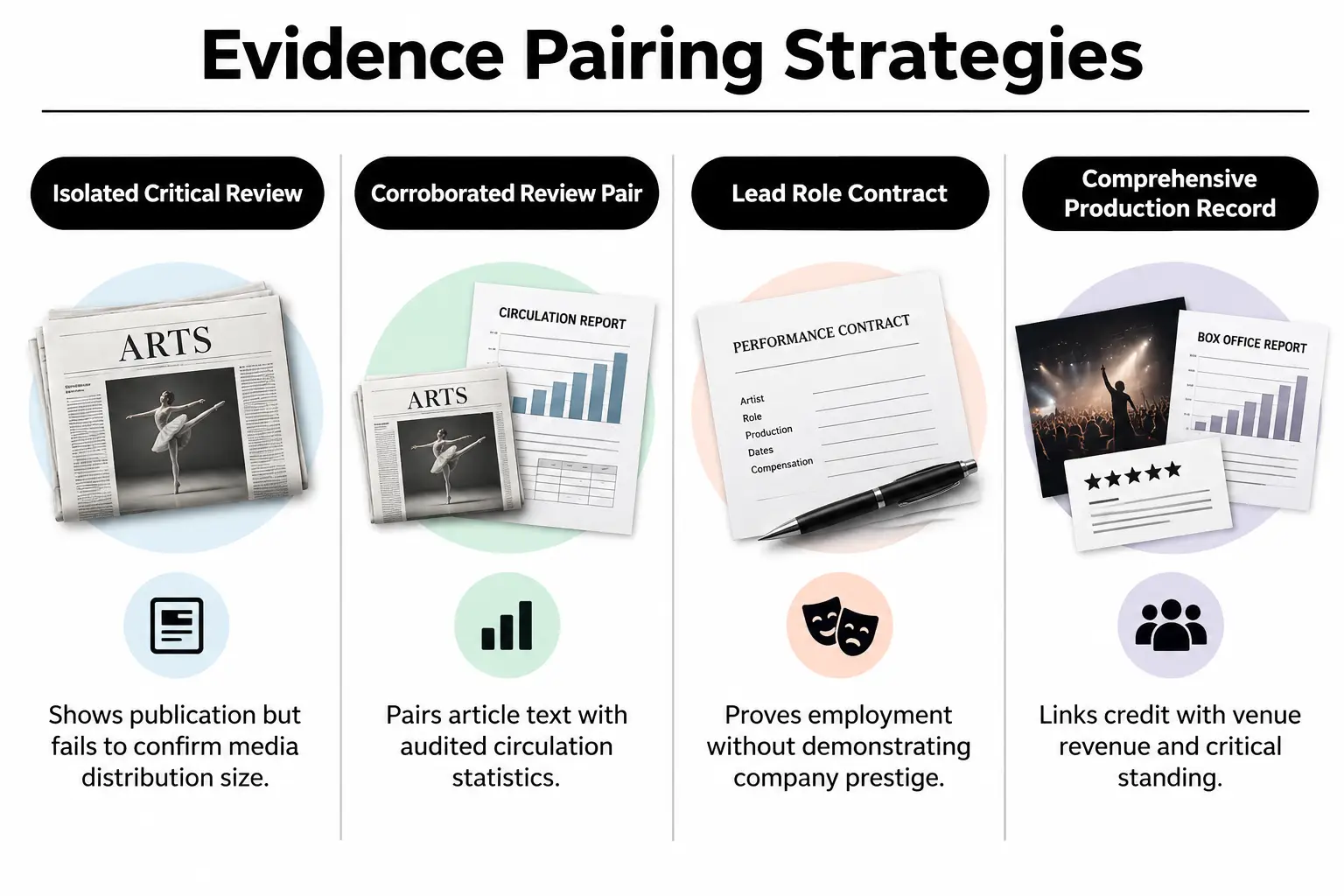
Pairing evidence with supporting records
Many applicants first work with an O-1 visa attorney or a P-1 visa attorney to maintain temporary work status. Those years are also a chance to collect evidence for an immigrant petition. Keep records as the work happens rather than trying to reconstruct them when you are ready to file.
Pairing a documented tour performance with national press and an expert advisory letter can address several criteria at once.
|
Starting Point |
Pairing Direction |
What to Sample or Test |
Intended Effect |
|---|---|---|---|
|
Major critical review |
The publication’s circulation figures and audience demographics. |
Circulation audits from independent monitoring agencies. |
Shows that the article appeared in leading media with national reach. |
|
Lead role in a production |
Records of the production company’s distinguished commercial standing. |
Industry rankings and revenue history, along with corporate awards. |
Establishes that the organization meets the regulatory standard for a distinguished reputation. |
|
High earnings records |
Bureau of Labor Statistics wage data for your metropolitan area. |
Regional wage percentile surveys for New Jersey and metropolitan centers. |
Shows where your income falls within the top five to ten percent of your field. |
Assembling an Audit-Ready Petition Packet
USCIS officers often spend less than thirty minutes on an initial filing. A confusing exhibit index or missing translation makes that review harder. At Abachi Law LLC, we verify documents before submitting an immigrant petition, so the officer can find the evidence behind each claim.
-
Choose core criteria: Start with the three or four categories where your records are complete and verifiable, without depending on disputed assumptions.
-
Check circulation and reputation: Obtain independent circulation figures for press coverage and audited visitor or financial records for the organizations presenting your work.
-
Request focused reference letters: Collect five to seven letters from independent industry leaders who have not directly employed or trained you.
-
Find comparable salary data: Use prevailing wage surveys from public labor records to compare your compensation with state and national figures.
-
Label exhibits clearly: Bind the legal brief with a detailed exhibit index. Give specific page references for every claim the brief makes.
Filing principle: Start each exhibit with a short sheet explaining which regulatory requirement it supports, so the officer never has to guess why it is there.
Managing Legal and Filing Expenses
Budget for more than the base USCIS filing fee and premium processing charges. Translation fees and media circulation reports add to the cost of legal representation. Asking about attorney fees for an EB-1 extraordinary ability petition early helps you reserve money for useful evidence rather than unnecessary filings.
|
Budget Level |
What to Prioritise |
What to Question |
|---|---|---|
|
Essential tier ($) |
Government filing fees and certified foreign document translations, plus basic peer references. |
Unvetted online public relations services selling quick media articles. |
|
Strategic tier ($$) |
Premium processing for 45-day adjudication, along with audited circulation reports and legal representation. |
Paid biographical entries in unaccredited national registries. |
|
Comprehensive tier ($$$) |
Full legal brief preparation and expert opinion letters, plus concurrent adjustment of status filings. |
Consultation firms that operate without recognized legal ethics oversight. |
Thorough preparation usually costs less than responding to an unexpected Request for Evidence or appealing a denial. Our firm offers qualifying applicants an option with a fee-refund policy. Review its terms as part of your budget planning; a fee arrangement does not determine whether USCIS will approve a petition.
Common Evidentiary Questions for Petitioners
Can I qualify for an EB-1A without major national awards?
Yes. Qualification requires meeting at least three of the ten criteria in 8 CFR 204.5(h) and passing the final merits review. USCIS routinely approves cases supported by critical roles and major media coverage, or high pay, rather than a single international honor.
How do artists qualify for talent-based permanent residency?
Artists need objective proof of sustained national or international acclaim. That can include critical exhibition reviews and leading roles for recognized companies, as well as major commercial sales. Each claim should show that peers recognize your work as setting or influencing professional standards.
Does holding an O-1B visa mean my EB-1A will be automatically approved?
No. An O-1B approval does not assure an EB-1A approval because the review standards differ. The O-1B standard calls for distinction or prominence. Under the stricter Kazarian final merits review, an EB-1A applicant must prove they have reached the very top of their field.
How do immigration changes affect performance tours across states?
Performers in temporary status need to track schedule changes closely. Knowing when tour changes require an amended petition helps you protect your current legal status in New Jersey. Address those obligations before moving ahead with a permanent residency filing.
Can recent graduates transition from student status directly to EB-1A?
Moving directly from F-1 practical training to EB-1A is legally possible, but difficult. Recent graduates rarely have the record needed to prove sustained national acclaim. Reviewing fixed-stay rules for student visas can help candidates plan a realistic, multi-year timeline that uses temporary visas first.
Next Steps for New Jersey Creative Professionals
Before filing, take a hard look at what your portfolio proves and what still needs support. For creative professionals living or working in New Jersey, we review that record against federal evidence rules. We also consider how petition planning fits around existing performance and exhibition dates.
-
Collect past press clippings and check each publication’s circulation figures.
-
Identify five independent industry leaders who can write detailed assessments of your work.
-
Gather complete payroll, 1099, or contract records to support claims about your pay.
-
Check the distinguished standing of each company or production you have headlined.
-
Review the documents showing you have maintained your current temporary status to prevent lapses.
Schedule a confidential portfolio assessment with an immigration attorney at Abachi Law LLC to identify which records support your petition and where more evidence is needed.
Legal disclaimer: This article is general information, not legal advice, and reading it does not create an attorney-client relationship. Laws change and differ from state to state, and past results do not guarantee a similar outcome. For advice about your own situation, speak with a licensed attorney at Abachi Law LLC.