
To move from OPT to O-1 status in New Jersey, file a petition with United States Citizenship and Immigration Services before your work authorization expires. That timing matters for maintaining lawful presence after post-completion Optional Practical Training, or OPT.
An Oscar, Emmy, or Grammy is not required for an O-1 visa. Your evidence can instead show distinction through critical roles and press coverage, supported by commercial results and advisory letters.
For an indie film editor in Jersey City or a graphic artist in Montclair, this route avoids the H-1B lottery cap. The same applies to studio session players along the Gold Coast. At our firm, we help match your portfolio to federal evidence standards while protecting your ability to keep working lawfully.
What’s Inside This Guide
- What is the True Meaning of Class O1B Visa Classifications?
- How Do You Structure an O-1 Evidentiary Portfolio on OPT?
- O-1A vs. O-1B: Which Route Fits Creative and Hybrid Roles?
- What Does It Cost to Hire an O-1 Visa Lawyer and File?
- What Mistakes Shorten Approval Periods or Trigger an RFE?
- Why Choose an Entertainment Visa Immigration Lawyer in New Jersey?
- Common Questions About O-1 Visa Transitions
- Plan Your Legal Strategy with Abachi Law LLC
What is the True Meaning of Class O1B Visa Classifications?
The O-1B standard requires “distinction” in the arts or extraordinary achievement in film or television. Under 8 CFR 214.2(o), distinction means a high level of achievement. Your evidence must show skill substantially above what is ordinarily encountered in your field.
An initial O-1B approval can last up to three years, based on an itinerary of events, productions, or creative engagements.
Independent graduates can use an agent petitioner to represent multiple end clients under an O-1B petition. That flexibility helps New Jersey artists whose work comes through short-term contracts. Dancers and animators, for example, may need to cover several clients rather than one employer.
Our detailed breakdown of the O-1B criteria explains the core standard and helps you compare it with your own body of work.
Unlike standard employer-sponsored categories, these creative professional visas let you combine commitments across production studios and agencies, including performance spaces around the country.
How Do You Structure an O-1 Evidentiary Portfolio on OPT?
During OPT, gather evidence that meets at least three of six standards, or shows a major, one-time international award. Work completed during your degree and practical training can help build your evidence file for an extraordinary ability petition. The task is to document those achievements against the required standards.
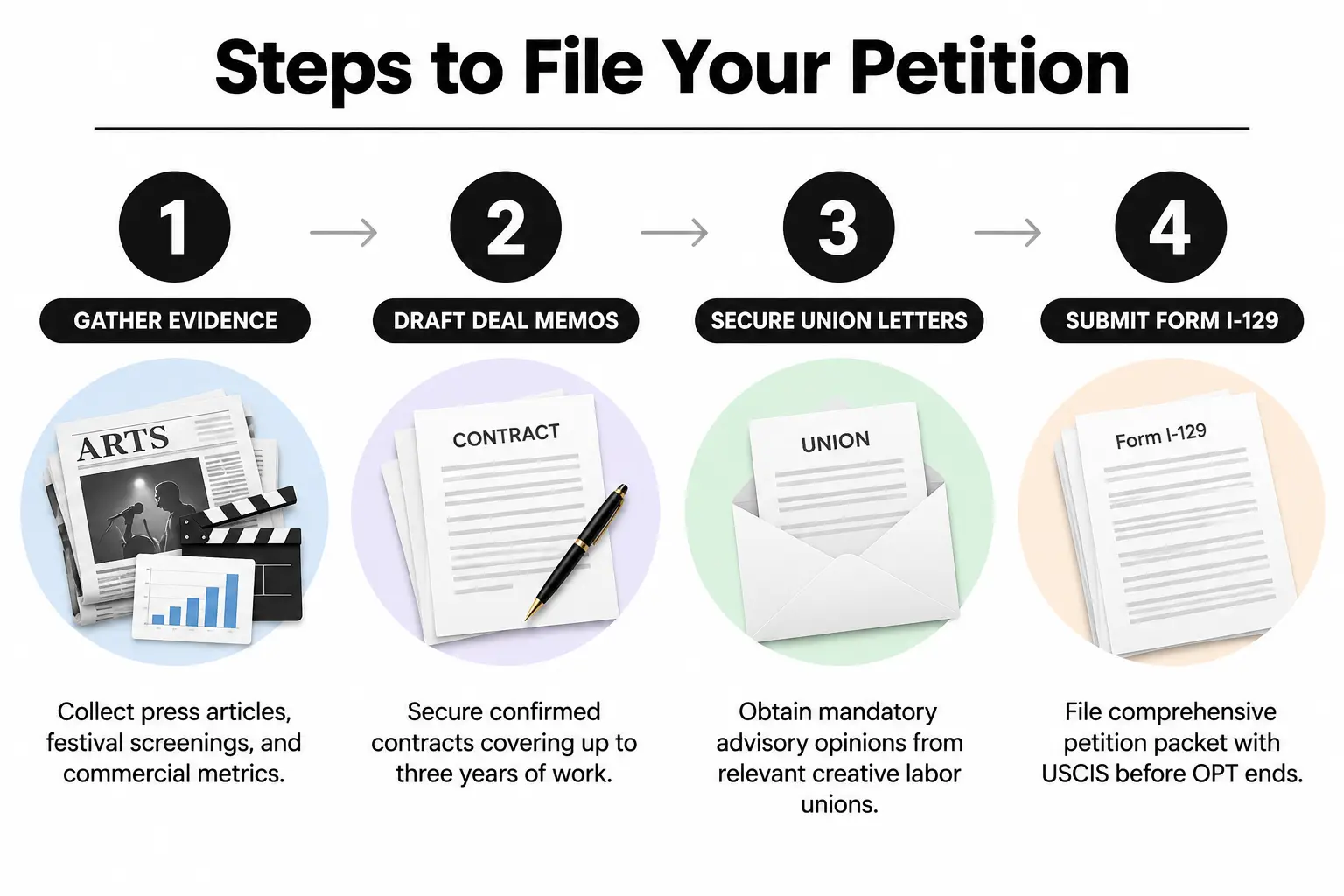
- Document lead or critical roles: Gather programs, credits, and contracts that show your essential role in productions or organizations with distinguished reputations.
- Collect published material: Save articles, trade reviews, and features in major publications about you or your creative projects.
- Show commercial or critical acclaim: Include box office receipts, streaming figures, festival screenings, or endorsements from prominent people in your industry.
- Get peer advisory opinions: Request the required formal consultation letters from labor unions that match your discipline, such as AFM, SAG-AFTRA, or IATSE.
Our guide to O-1B evidence criteria explains how digital metrics, gallery shows, and achievements in niche fields can support a petition. For expert statements, see our guide to writing testimonial letters for artists. It covers how to present expert testimony in support of an O-1B filing.
O-1A vs. O-1B: Which Route Fits Creative and Hybrid Roles?
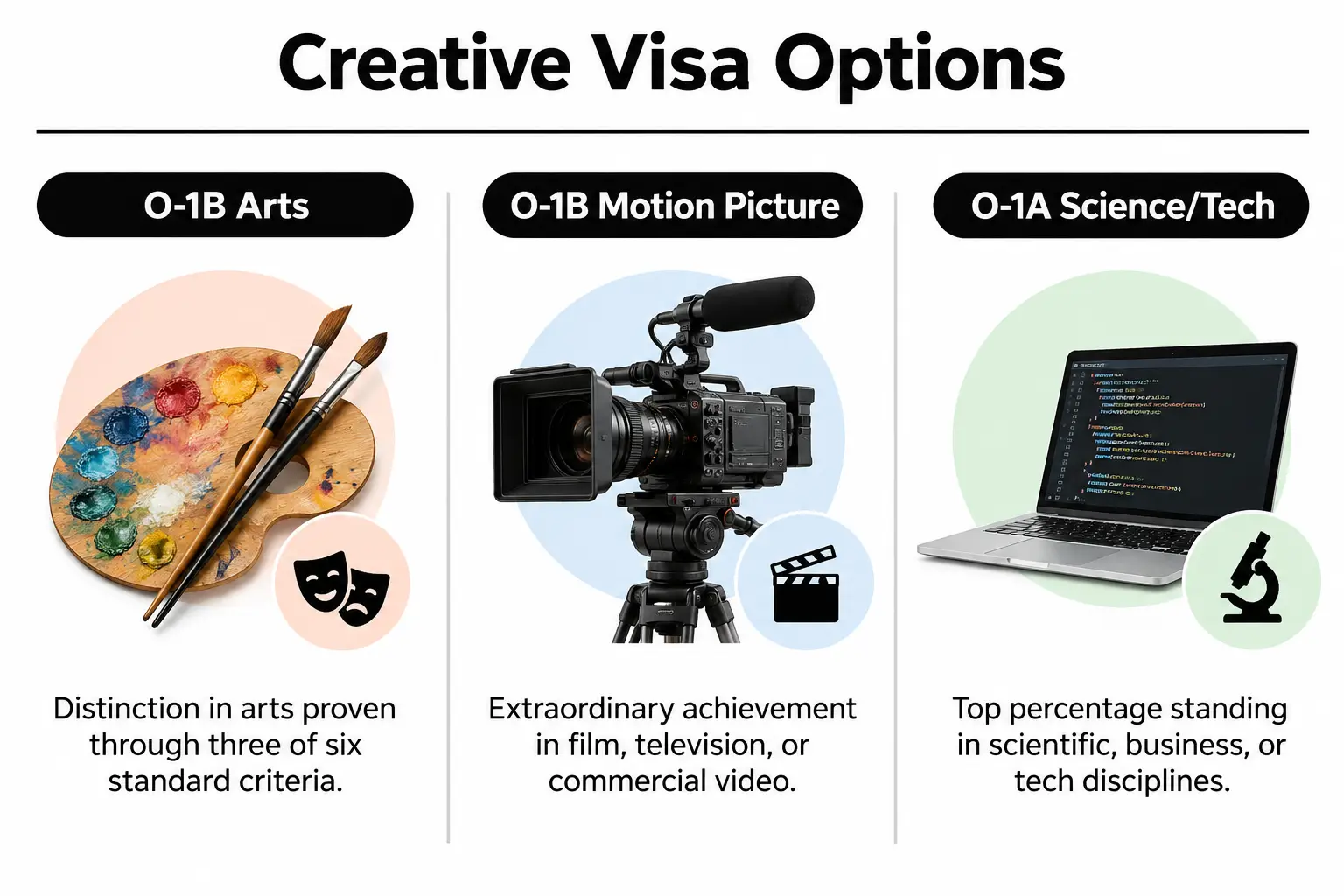
O-1A covers science, business, education, and athletics. O-1B covers the arts, film, and television. Choosing between them can be difficult for people whose work crosses fields, including UI/UX designers who design digital interfaces and user experiences. Creative technologists and interactive game producers face the same choice.
| Classification | Best suited to | What to watch for |
|---|---|---|
| O-1B (Arts) | Musicians, visual artists, animators, set designers, and theatrical performers. | Evidence must show distinction among peers, rather than technical scientific citations. |
| O-1B (Motion Picture/TV) | Cinematographers, film directors, lead actors, and commercial producers. | The “extraordinary achievement” standard is stricter than the general arts standard. |
| O-1A (Sciences/Tech) | Creative directors with coding backgrounds, software architects, and tech innovators. | Evidence must place you among the small percentage at the top of your field. |
Musicians can find more detail in our guide to U.S. artist visas, tour planning, and P-1B rules. At Abachi Law LLC, we regularly help musicians and singers with visa petitions that cover work at multiple venues.
What Does It Cost to Hire an O-1 Visa Lawyer and File?
Your legal fee depends on the complexity of your itinerary and the number of criteria claimed. Using an agent petitioner also affects the work involved. Most boutique practices charge a disclosed flat fee for O-1 filings. USCIS filing fees and required union advisory opinion fees are separate out-of-pocket costs.
Government charges include the Form I-129 petition fee and the asylum program fee. Premium processing is optional and expedites the government’s review to 15 business days. Check the current filing fees on the USCIS website before budgeting for your petition.
Our breakdown of O-1B processing times explains the 15-day expedited option and can help you decide if your performance dates call for it.
Experienced counsel helps prevent costly filing mistakes. Part of that work is drafting deal memos and contracts to support the full three-year approval period.
What Mistakes Shorten Approval Periods or Trigger an RFE?
A vague itinerary with large gaps between projects is the most common mistake. USCIS officers routinely issue a Request for Evidence (RFE), asking for more documentation, or shorten the approval period. Missing dates, unconfirmed venues, and unclear pay terms can all cause problems.
Practitioner’s rule: Do not file an O-1 itinerary built on speculative bookings. Every deal memo needs clear pay terms, specific dates, and a description of the actual project.
Misstating your relationship with an agent petitioner is another serious risk. Include a signed agency agreement authorizing the petitioner to act for you on every listed engagement. Our 2025 guide to securing a U.S. artist visa explains the paperwork and how to avoid these filing mistakes.
Why Choose an Entertainment Visa Immigration Lawyer in New Jersey?
Working with a local lawyer gives you access to counsel who knows the New York metropolitan creative sector and New Jersey’s arts community. For artists in Hoboken, Newark, Princeton, and Asbury Park, that includes familiarity with regional arts councils. Local counsel also understands union chapters and performance venues within the state.
A search for an O-1 visa lawyer may bring up high-volume firms that take weeks to assemble a brief. Choosing an attorney familiar with creative work matters too. As a boutique firm, Abachi Law LLC gives the details of your work hands-on attention.
Local counsel can also help connect temporary status with your plans for permanent residency. A P-1 visa attorney or O-1 attorney in New Jersey can review those options. Our guide explains the steps for moving from O-1B status to an EB-1A green card without gaps.
For a review of longer-term EB-1 or P-1 options, schedule a visa evaluation so we can assess your credentials.
Common Questions About O-1 Visa Transitions
Can I work for multiple clients on an O-1 visa?
Yes, a legitimate U.S. agent can file as your petitioner for work with multiple clients. Include a complete itinerary with deal memos, letters of intent, or contracts that describe each client engagement.
What are the primary o1b visa requirements for creative fields?
Federal rules require a one-time major award or evidence meeting at least three of six criteria. Those criteria include past or upcoming lead roles in distinguished productions and critical reviews. Commercial success and endorsements from recognized organizations or peers can also form part of the evidence.
How soon should I start transitioning from opt to o1 visa status?
Start collecting evidence and identifying potential petitioners at least six months before your OPT authorization expires. Preparing deal memos takes time, as does obtaining the required union consultation letters. Leave room in that schedule to gather your press materials too.
Does moving to an O-1 help me qualify for an EB-1A green card?
Approval of an O-1 petition establishes a record of distinction that can support a later EB-1A self-petition. EB-1A has a higher legal standard, but the evidence collected for your O-1 directly supports your immigrant petition.
Plan Your Legal Strategy with Abachi Law LLC
At Abachi Law LLC, we work directly with artists, designers, and performers moving from student status into independent creative work in New Jersey. Our role is to build extraordinary ability petitions that hold up under USCIS review and make the process manageable.
We help prepare multi-year agency itineraries and compliant deal memos, along with the union letters required for approval. To review the next steps for your petition, contact our office.
Legal disclaimer: This article is general information, not legal advice, and reading it does not create an attorney-client relationship. Laws change and differ from state to state, and past results do not guarantee a similar outcome. For advice about your own situation, speak with a licensed attorney at Abachi Law LLC.