You do not need international runway credits or a major fashion trophy to qualify for an O-1B artist visa. United States Citizenship and Immigration Services (USCIS) assesses fashion models under the arts category for talent-based visas. Commercial campaigns and major magazine features can establish distinction, as can high pay, without competitive industry prizes.
Your main modeling market shapes the evidence you submit. Haute couture shows get plenty of attention, but commercial contracts and national e-commerce campaigns also carry weight under federal rules. Lookbooks for recognized labels and cosmetics ads matter too. Without fashion week credits, focus on documented commercial work and agency representation rather than treating runway recognition as a requirement.
What’s Inside This Guide
-
Choosing Between Commercial Evidence and Editorial Distinction
-
Structuring Your Representation: Single Employer or Agency Petitioner
Why Relying on Runway Awards Holds Models Back
Many foreign models assume they need Paris, Milan, or New York Fashion Week credits to obtain an artist visa. That belief can lead them to delay filing or accept poor representation. Runway work is only part of the fashion business. USCIS officers review the full career record, not runway credentials alone.

Reviewing campaign tear sheets with an attorney
Chasing awards can leave a petition short on useful proof. Fashion honors rarely resemble the formal prizes found in film or music. Modeling competitions are uncommon and rarely meet the evidence standards in the federal regulations. An award-focused filing can leave gaps that prompt a Request for Evidence (RFE), a USCIS request for more documentation.
Commercial work gives you concrete evidence of your value in the market. Brand partnerships and e-commerce lookbooks help document your standing, alongside advertising spreads or cosmetics packaging. Models working in Jersey City studios or shooting campaigns elsewhere in New Jersey can use their regular paid work to build a substantial record.
Practical check: Documented commercial day rates and prominent ad campaigns give USCIS more to assess than unsupported claims of runway prestige.
Choosing Between Commercial Evidence and Editorial Distinction
Before preparing a filing, decide which part of your career the evidence supports most clearly. Models must meet at least three of six regulatory criteria unless they have a major one-time international achievement. A portfolio built on broad commercial reach needs a different explanation from one centered on editorial prestige. We use that distinction to organize the record.
Defining Your Primary Portfolio Track
Editorial work shows cultural recognition and critical acclaim, while commercial work shows market demand and high pay. Most successful petitions include both, but a clear focus helps an officer understand your standing. The evidence should reflect the work you actually book, rather than force your career into a story about runway success.
|
Option |
Recommended Starting Point |
What to Watch |
|---|---|---|
|
Commercial advertising |
National brand campaigns, e-commerce bookings, cosmetics packaging |
Check that contracts confirm your day rates and show where images appeared across major markets. |
|
Editorial print work |
Magazine covers, multi-page spreads, masthead fashion features |
Avoid uncredited background shots or digital-only blogs without documented circulation figures. |
|
Mixed fashion portfolio |
A mix of high-fashion editorials and well-paid brand shoots |
Explain how the work fits together so officers do not mistake commercial success for a lack of artistic standing. |
|
Digital and social brand endorsements |
Verified influencer campaigns, sponsored lookbooks, digital retailer ads |
Supply engagement figures and signed contracts, along with brand press releases, rather than screenshots alone. |
For artists qualifying through extraordinary ability without major prizes, objective records matter. High daily earnings and published spreads in recognized magazines can demonstrate distinction, as can promotional displays in retail spaces. An attorney familiar with these petitions can connect each piece of evidence to the relevant legal standard.
Structuring Your Representation: Single Employer or Agency Petitioner
Most models work freelance for several clients, which makes the petitioner requirement an important early decision. A petitioner is the employer or agent that files on your behalf. You cannot simply file an O-1 self-petition. The filing arrangement needs to support the work you plan to accept during your stay.
Federal rules allow a direct employer or an agent to petition. A modeling agency can act as your agent-petitioner, or a management company can file for several upcoming employers. This arrangement can cover bookings across runway and digital media, plus print or video advertising, without a separate petition for each client.
|
Situation or Style |
Recommended Choice |
Avoid |
|---|---|---|
|
Exclusive brand ambassador |
A petition from the single direct employer |
Do not use this arrangement if you plan to accept outside freelance editorial or runway work. |
|
Freelance model with several clients |
An agency petitioner acting for multiple employers |
Avoid an inactive shell company with no verifiable production history. |
|
Moving from F-1 OPT |
A U.S. management agency with confirmed deal memos for several projects |
Submit well before practical training authorization expires to address possible gaps in work authorization. |
|
Model signed to an international agency |
A U.S. affiliate agency or established talent management firm |
Avoid vague itineraries without definite work dates, locations, and pay rates. |
Agent rule: An authorized agent can combine brand bookings and editorial shoots under one petition with a three-year itinerary.
Our explanation of the petitioner’s role covers multi-employer arrangements in more detail. Use it to understand how the contracts and itinerary fit Department of Homeland Security requirements before choosing who will file.
Aligning Contracts, Itineraries, and Advisory Opinions
The filing needs enforceable booking contracts and a detailed work schedule. It also requires a written advisory opinion from an appropriate peer group or labor union. Weak documentation in any of these areas can delay the petition, even if your portfolio contains strong evidence of recognition.
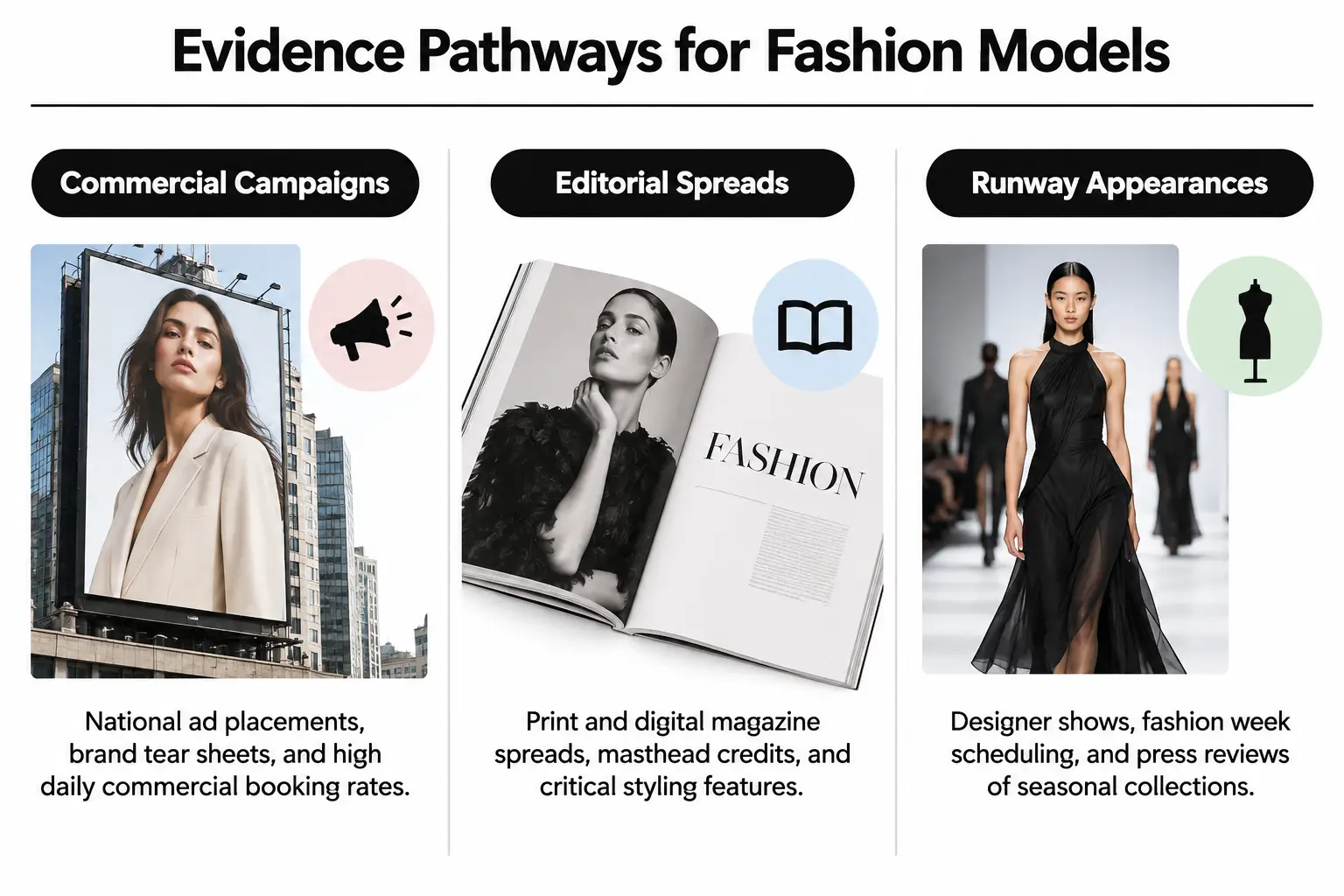
Commercial and editorial evidence for fashion models
An itinerary must show confirmed creative work during the requested petition period, which can last up to three years. Bookings need not fill every day, but the schedule must be credible. Deal memos, which record booking terms, help establish that schedule alongside letters of intent and agency representation agreements.
|
Starting Point |
Pairing Direction |
What to Sample or Test |
Intended Effect |
|---|---|---|---|
|
Signed representation contract |
Agency deal memo stating commission and booking terms |
Check the clause authorizing the agent |
Establishes the petitioner’s legal authority to file for you |
|
Project deal memos |
A production schedule covering New Jersey and regional hubs |
Check project dates, locations, and pay |
Supports the full requested three-year period |
|
Peer advisory opinion |
A formal consultation letter from the relevant union or peer organization |
Check that the group’s authority covers modeling or the arts |
Meets the required consultation under 8 CFR |
|
Expert testimonial letters |
References from recognized art directors and designers |
Check that letters describe specific artistic contributions |
Supports claims of extraordinary standing and commercial impact |
Generic praise does little for a support letter. Officers want specific accounts from photographers, art directors, or label executives explaining why a campaign needed you. Those accounts should connect your look and professional reputation to the actual assignment. Our guide to preparing testimonial letters explains how to develop that detail.
The Step-by-Step Evidence Gathering Process
Useful evidence is often scattered across personal files, social feeds, and agency portals. Models may already have substantial material without knowing how it supports a petition. We recommend gathering it in a set order, so you can see what is documented and what still needs outside confirmation:
-
Review published tear sheets and digital campaigns: Gather clear digital copies of published magazine pages, known as tear sheets. Include billboard photos, catalog covers, and e-commerce pages showing your name or recognizable likeness.
-
Show the publication’s reach: Collect circulation figures and distribution records for each magazine or brand outlet that published your work. Media kits can help document those numbers.
-
Document high pay: Collect 1099 statements and tax records, plus agency payment summaries and booking vouchers. Compare your hourly, daily, or project rates with industry wages using sources such as the Bureau of Labor Statistics.
-
Request peer testimonial letters: Seek 5 to 7 detailed letters explaining your artistic distinction. Prominent fashion photographers, commercial directors, or brand founders can describe the work they know firsthand.
-
Complete the work itinerary: Work with your petitioner to sign binding contracts or letters of intent covering your planned assignments across the United States.
Evidence rule: Each published image submitted to USCIS needs third-party circulation or distribution records showing that the outlet reaches an established audience.
Students on post-completion practical training need to plan document collection around their authorization’s expiration date. Starting before the card expires helps address possible gaps in lawful work. Recent regulatory developments also need attention, including the policies discussed in our coverage of fixed-stay rules and practical training.
Planning Costs and Timelines for Your Petition
Budget for government filing fees and union consultation charges, along with translation costs and legal fees. Planning those expenses early leaves room to gather missing records rather than cutting preparation short to meet a booking deadline.
Government fees follow federal rules, while the filing plan depends partly on whether you request USCIS premium processing. Models with approaching shoot dates or sudden agency offers often choose expedited review. That request concerns the processing timeline, not a promise that USCIS will approve the petition.
|
Budget Level |
What to Prioritise |
What to Question |
|---|---|---|
|
Essential legal filing ($) |
Standard USCIS Form I-129 fee, required union peer review letter, core evidence collection |
Avoid filing before circulation records and certified translations are complete. |
|
Expedited timeline ($$) |
Form I-907 premium processing fee for expedited USCIS review, courier delivery |
Consider whether faster review is necessary if your current work authorization lasts several more months. |
|
Comprehensive preparation ($$$) |
Detailed market research reports, full expert evaluations, multi-employer agency arrangements |
Avoid paying publicists for artificial press placements that USCIS may discount as paid advertising. |
Put the evidence budget toward legitimate circulation reports and consultations with recognized experts. Paid vanity awards and manufactured press can draw scrutiny rather than establish the recognition your petition needs.
At Abachi Law LLC, we review a candidate’s record and explain our petition services and engagement terms. Our work focuses on assessing the evidence and preparing the filing, while the immigration authorities decide the outcome.
Common Questions About Model Visa Approvals
Can I qualify for an O-1B visa without major awards?
Yes. Meeting at least three alternative evidence criteria can support eligibility without an industry award. USCIS approves fashion model petitions based on documented commercial campaigns and high earnings, among other evidence. Major media coverage and critical roles for distinguished apparel brands can also support the record.
How do artists qualify for an O-1 visa when working freelance?
Freelancers use an authorized U.S. agent or talent management company as the petitioner. That agent submits a schedule of confirmed or anticipated bookings with deal memos supporting the assignments. The arrangement allows the professional to work legally on projects for multiple clients.
Does commercial e-commerce modeling count as extraordinary ability?
E-commerce work counts when the evidence shows substantial market reach and national retail distribution, with pay well above industry averages. A high volume of bookings for major retailers can document professional demand and commercial success. The filing needs records supporting those claims, rather than portfolio images alone.
What is the difference between an O-1B and a P-1 visa for performers?
O-1B classification covers individual artists who show distinction or extraordinary achievement in the arts. Work handled by a lawyer handling P-1 petitions typically concerns internationally recognized athletes or entertainment groups, rather than solo commercial models. Our discussion of tour planning for musical artists explains the group-performance context.
Can an O-1B model visa lead to a green card later?
An O-1B can provide a starting point for a later EB-1A extraordinary ability green card petition. Permanent residence has stricter standards. An attorney handling EB-1 petitions can assess how your existing portfolio supports those standards and what further evidence you need over time.
Moving Forward with Your Model Visa Petition
At Abachi Law LLC in New Jersey, we help models assess their records and prepare the documents needed for a filing. Before setting a petition date, check that your career evidence and planned U.S. work are both documented. Use this checklist to identify what still needs attention:
-
Tear sheet verification: Check that every portfolio spread clearly shows your work and matches the publication’s media records.
-
Pay records: Gather contracts and invoices, along with payment vouchers, showing above-average day rates.
-
Petitioner agreement: Complete your agency contract or management representation agreement.
-
Consultation letters: Identify qualified peers who can explain and support your professional distinction.
-
Filing schedule: Plan dates around your legal status and upcoming shoots to address possible gaps or disruptions.
For an assessment of your portfolio and eligibility, contact Abachi Law LLC.
Legal disclaimer: This article is general information, not legal advice, and reading it does not create an attorney-client relationship. Laws change and differ from state to state, and past results do not guarantee a similar outcome. For advice about your own situation, speak with a licensed attorney at Abachi Law LLC.