

For established music groups with international recognition, talent-based visas under P-1B are generally the most direct route to a U.S. tour. Immigration officers assess the group together, rather than treating each member as a soloist. Choosing the right category early helps keep opening night on schedule.
A changing lineup, a solo headliner with hired musicians, or little shared performance history calls for a different approach. An O visa for artists provides stability for individual performers. It does, however, require separate petitions for each principal artist and their essential support staff.
What’s Inside This Guide
- Why Tour Scheduling Collapses Without Early Classification
- Selecting the Visa Vehicle for Ensemble and Solo Acts
- Aligning Group Structure with Petitions and Union Requirements
- Integrating Crew, Venues, and Multi-City Schedules
- Executing the Petition Filing Sequence Under Tight Timelines
- Allocating Legal and Processing Budgets for Touring Ensembles
- Direct Answers on Musical Artist Visa Petitions
- Planning Your U.S. Tour With Legal Precision
Why Tour Scheduling Collapses Without Early Classification
Tour dates leave little room for paperwork delays. Promoters booking venues in Newark, Jersey City, or Asbury Park commit money to deposits and promotion months before artists reach border control. One filing mistake can put the whole schedule on hold.

Treating freelance gig schedules like ordinary corporate employment is a common source of trouble. International ensembles often have no single permanent U.S. employer. Their work instead rests on separate promoter agreements, festival bookings, and venue contracts across dozens of jurisdictions.
Practical check: Filing without a petitioner covering the tour or contracts that fit together triggers immediate evidence requests that can delay gigs by four to eight weeks.
U.S. Citizenship and Immigration Services issues a Request for Evidence when a filing fails to prove a track record or puts touring members in the wrong category. This is a formal request for more documentation. Answering it as show dates approach can force expensive emergency motions or last-minute cancellations.
Selecting the Visa Vehicle for Ensemble and Solo Acts
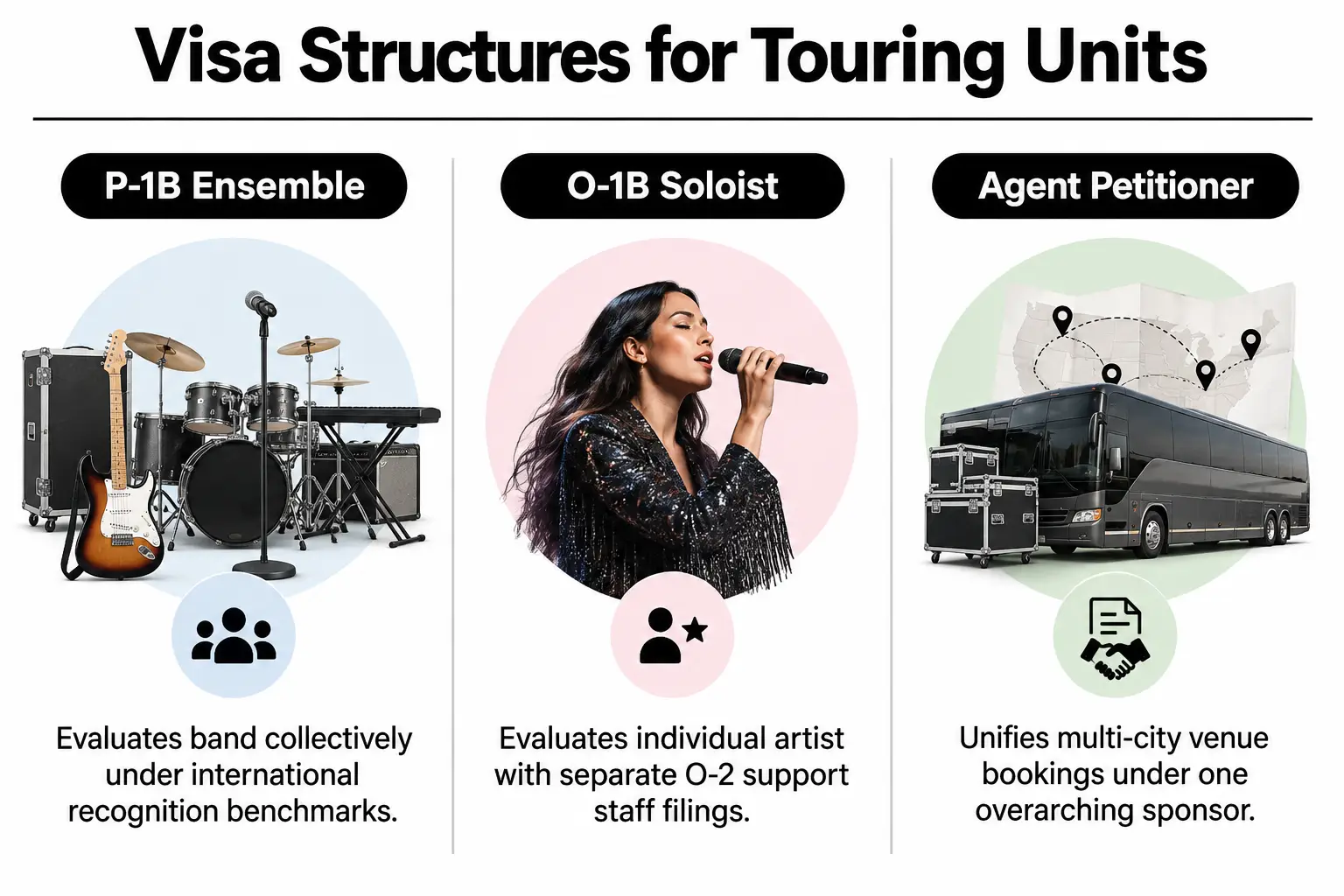
We start by looking at whether P-1B or O-1 status fits the act. P-1B is for internationally recognized entertainment groups that have performed together regularly for at least one year. Solo musicians cannot qualify for this category on their own.
Video: A guide to P-1B visas for internationally recognized entertainment groups (Tewary Immigration Law)
Comparing the Core Filing Frameworks
Solo artists need a talent-based visa approach built around the individual O-1B category. Backing musicians and crew then file under O-2 essential support status. That classification ties their entry directly to the O-1 headliner, rather than giving them independent permission to work.
| Filing Option | Recommended Starting Point | What to Watch |
|---|---|---|
| P-1B Entertainment Group | Bands with a shared name and a history of performing together | At least 75 percent of members must have performed with the group for one full year. |
| O-1B Solo Headliner with O-2 Crew | Solo headliners who use rotating touring musicians | Support crew must show critical skills and prior experience working with that particular solo artist. |
| Individual O-1B Petitions for All | Supergroups or collaborations between established soloists | More paperwork, because every member must independently meet the extraordinary ability requirements. |
Artists considering permanent U.S. residence later can establish a recognized benchmark by securing an O-1B artist visa. Evidence gathered for that temporary status can support a later self-petition for permanent residence. An attorney handling extraordinary ability petitions can help connect that record to the permanent residence filing.
Aligning Group Structure with Petitions and Union Requirements
Your visa choice needs to match the artistic record you can document now. Officers look at evidence such as chart positions, streaming figures, critical reviews, and commercial sales. General praise from personal contacts will not meet the evidence requirements, even if those contacts know your work well.
| Situation or Style | Recommended Choice | Avoid |
|---|---|---|
| Long-established band with recent lineup changes | P-1B petition clearly documenting compliance with the 75 percent rule | Adding new session players without checking how many members meet the one-year requirement. |
| Independent recording artist touring mid-sized venues | O-1B visa filed through an established booking agency or petitioner | Filing separate petitions with each venue acting as its own employer. |
| International graduate completing an F-1 program | Direct transition to O-1B before optional practical training (OPT) expires | Letting work authorization expire while playing unpaid gigs to stay visible. |
Filing rule: Never submit a petition without an advisory opinion from the appropriate labor organization, such as the American Federation of Musicians.
Every entertainment petition needs a written consultation from the appropriate peer group or labor union. For instrumentalists, the musicians’ union reviews contracts and the itinerary, along with members’ qualifications. Skipping that review leads to immediate rejection by immigration officers for failing to follow the required procedure.
Integrating Crew, Venues, and Multi-City Schedules
Sound engineers and lighting directors keep live shows running, alongside stage managers and instrument technicians. These workers do not qualify on their own under the main talent categories. Instead, P-1S or O-2 essential support status allows them to enter with the act they support.
| Starting Point | Pairing Direction | What to Sample or Test | Intended Effect |
|---|---|---|---|
| P-1B Ensemble | P-1S Support Personnel | Past tour logs, familiarity with specialized gear, and records of work with the band | Allows foreign technical crew to run the band’s specific production equipment during live shows. |
| O-1B Principal Performer | O-2 Support Personnel | Evidence that the assistant is essential to the live performance | Keeps performance quality consistent without hiring local crews unfamiliar with the arrangements. |
| Multi-Venue Tour Booking | Itinerary-Backed Petition | Signed performance contracts, detailed itineraries, and deal memos | Provides continuous work authorization, including gaps between performances across the country. |
Freelance performers often move from regional festivals to college halls and club residencies, with no single venue covering the whole tour. Working with an agent who can petition for freelance artists is critical. That agent acts as the legal petitioner, bringing dates in several cities into one filing that meets immigration requirements.
Executing the Petition Filing Sequence Under Tight Timelines
Each stage of the application has paperwork that must be completed before the next step. Rushing ahead without the evidence to support a filing creates avoidable problems.
- Draft performance agreements: Confirm dates, venues, payment terms, and technical riders for every planned show.
- Secure union consultations: Send contracts and artist materials to the appropriate labor organizations for their review letters.
- Assemble evidentiary exhibits: Gather press coverage, recording credits, streaming figures, and professional reference statements.
- Submit Form I-129 to USCIS: File the petition with the required supplements, filing fees, and union letters.
- Complete consular processing: After petition approval, performers schedule visa interviews at their local U.S. embassy abroad.
Timeline warning: File at least four to six months before rehearsals begin. Otherwise, premium processing becomes necessary to avoid missing opening night.
Recent agency updates can affect how officers assess your evidence. Reading about changes in the new immigration memo helps management teams account for those shifts before filing. You can also reach out to our team to discuss the specific deadlines your tour needs to meet.
Allocating Legal and Processing Budgets for Touring Ensembles
A tour’s immigration budget needs to cover government filing fees and union reviews, as well as legal representation. Saving money by skimping on preparation often costs more later. Fixing paperwork errors under a tight deadline can add expenses just as other tour bills come due.
| Budget Level | What to Prioritise | What to Question |
|---|---|---|
| Lean Tour Budget ($) | Standard USCIS filing fees and formal labor union consultation reviews | Unlicensed intermediaries promising direct consulate appointments without filed petitions. |
| Mid-Tier Production ($$) | Premium processing to confirm dates before booking non-refundable international flights | Repeated petition amendments for small venue changes within an existing tour itinerary. |
| Full Stage Ensemble ($$$) | Complete P-1S filings for technical directors and backline crew | Hiring local replacements for individual shows who need lengthy on-site training. |
Government fees set by USCIS are fixed. Paying for premium processing speeds up an artist’s U.S. tour petition and ensures a response within fifteen calendar days. That faster response avoids costly venue cancellations when the filing schedule is tight.
Direct Answers on Musical Artist Visa Petitions
Can solo acts apply for a P-1B visa?
No. Federal regulations do not allow solo musical performers to qualify for P-1B status. A solo musician must seek O-1B status based on individual recognition, while accompanying musicians may apply for O-2 support status.
What is the 75 percent rule for touring bands?
At least 75 percent of performing members must have been an integral part of the group for a minimum of one year. Federal law allows the remaining members to be newer additions, as long as the ensemble’s core identity stays the same.
Can a musical group enter the country on visitor visas to perform?
Entering on a B-1 or B-2 visitor visa to perform for a paying public audience is strictly prohibited by federal immigration law. Live shows generally require the appropriate P or O classification, even if the performers are not paid.
How far in advance should we file our petition?
Petitions cannot be filed more than six months before the first scheduled performance. Filing four to five months before that date leaves time for standard processing without paying the government’s premium processing fees.
What happens if we add dates to our tour after approval?
Extra dates often need only an updated itinerary if they fall within the approved period and involve similar musical performances. Major changes to sponsors or the type of performance may require an amended petition with the agency.
Planning Your U.S. Tour With Legal Precision
Work authorization needs attention long before production freight ships. At Abachi Law LLC, we help ensure your touring documents and band rosters meet federal requirements from the start. Performance agreements need to meet those requirements too, so the filing reflects the tour you actually plan to play.
Before committing to bookings, check these parts of your tour preparation:
- Verify group continuity: Confirm that at least three-quarters of the touring group has played together for a full year.
- Draft comprehensive itineraries: Record every venue and performance contract, plus off-day locations in each state.
- Request union advisory letters: Contact the appropriate labor organization well before submitting the federal petition.
- Assemble critical press records: Gather album reviews, major festival bills, streaming figures, and chart rankings.
- Review international passports: Check that every touring member has a valid passport with at least six months remaining.
For help preparing your ensemble’s petition for upcoming East Coast dates, contact our team at Abachi Law LLC before moving ahead with bookings.
Legal disclaimer: This article is general information, not legal advice, and reading it does not create an attorney-client relationship. Laws change and differ from state to state, and past results do not guarantee a similar outcome. For advice about your own situation, speak with a licensed attorney at Abachi Law LLC.